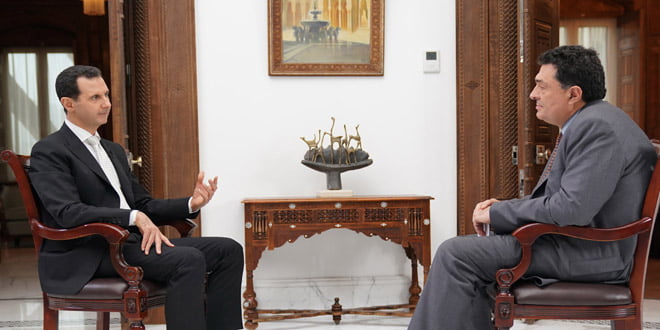
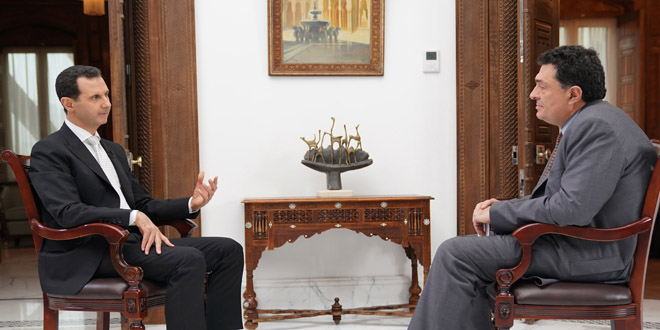

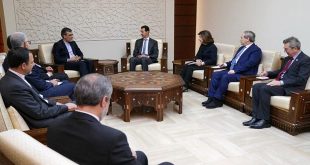
Damascus, SANA – President Bashar al-Assad said that France, Britain, and the US, along with Saudi Arabia, Qatar, and Turkey are responsible for the war in Syria due to their support of the terrorism, describing the Western allegations about the use of chemical weapons by the Syrian Arab Army as a farce and a very primitive play whose only goal is to attack the Syrian Army after the defeat of terrorists.
In an interview given to the Greek Kathimerini newspaper, President al-Assad said that Syria is fighting terrorists, who are the army of the Turkish, US, and Saudi regimes, stressing that any aggressor and any army, whether Turkish, French, or whoever, they are all enemies as long as they came to Syria illegally.
Following is the full text of the interview:
Journalist: Mr. President, thank you very much for agreeing to do this interview. It’s a pleasure to be here in Damascus.
President Assad: You’re most welcome in Syria.
Question 1: Let me ask you first of all, you know, there’s been accusation by the US and the Europeans about the use of chemical weapons, and there was an attack after that. What is your response to that? Was there a chemical attack? Were you responsible for it?
President Assad: First of all, we don’t have any chemical arsenal since we gave it up in 2013, and the international agency for chemical weapons made investigations about this, and it’s clear or documented that we don’t have. Second, even if we have it, we wouldn’t use it, for many different reasons. But let’s put these two points aside, let’s presume that this army has chemical weapons and it’s in the middle of the war; where should it be used? At the end of the battle? They should use it somewhere in the middle, or where the terrorists made advancement, not where the army finished the battle and terrorists gave up and said “we are ready to leave the area” and the army is controlling fully that area. So, the Western narrative started after the victory of the Syrian Army, not before. When we finished the war, they said “they used chemical weapons.”
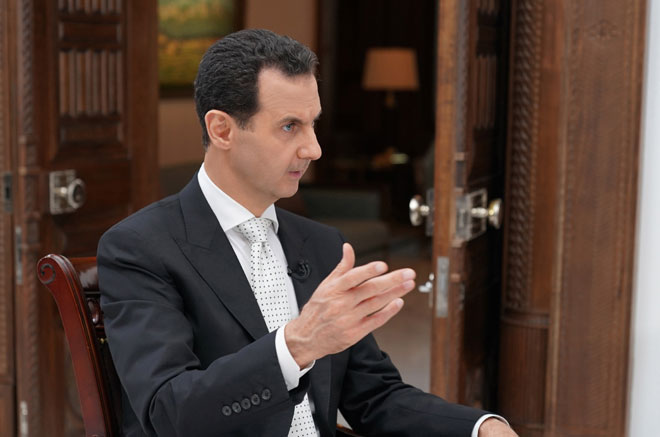
Second, use of mass destruction armaments in a crammed area with a population like Douma – the supposed area, it’s called Douma and they talk about 45 victims- when you use mass destruction armaments in such an area, you should have hundreds or maybe thousands of victims in one time. Third, why all the chemical weapons, the presumed or supposed chemical weapons, only kill children and women? They don’t kill militants. If you look at the videos, it’s completely fake. I mean, when you have chemical weapons, how could the doctors and nurses be safe, dealing with the chemical atmosphere without any protective clothes, without anything, just throwing water at the victims, and the victims became okay just because you washed them with water. So, it’s a farce, it’s a play, it’s a very primitive play, just to attack the Syrian army, because… Why? That’s the most important part, is that when the terrorists lost, the US, France, UK, and their other allies who want to destabilize Syria, they lost one of their main cards, and that’s why they had to attack the Syrian Army, just to raise the morale of the terrorists and to prevent the Syrian Army from liberating more areas in Syria.
Question 2: But are you saying that there was an incident of chemical attack and someone else is responsible, or that there was nothing there?
President Assad: That’s the question, because, I mean, the side who said – allegedly – that there was a chemical attack, had to prove that there was an attack. We have two scenarios: either the terrorists had chemical weapons and they used them intentionally, or maybe there was explosions or something, or there was no attack at all, because in all the investigations in Douma people say “we didn’t have any chemical attack, we didn’t see any chemical gas, or didn’t smell” and so on. So, we don’t have any indications about what happened. The Western narrative is about that, so that question should be directed to the Western officials who said there was an attack. We should ask them: where is your concrete evidence about what happened? They only talk about reports. Reports could be allegations. Videos by the White Helmets, the White Helmets are funded by the British Foreign Office, and so on.
Question 3: President Trump, in a tweet, used a very strong expression. He said “animal Assad.” You remember that? What is your response to that?

President Assad: Actually, when you are in that position, I mean president of a country, you have first of all to represent the morals of your people before representing your own morals. You are representing your country. Question: does this language represent the American culture? That is the question. This is very bad, and I don’t think so. I don’t think there’s a community in the world that has such language. Second, the good thing about Trump is that he expresses himself in a very transparent way, which is very good in that regard. Personally, I don’t care, because I deal with the situation as a politician, as a president. It doesn’t matter for me personally; what matters is whether something would affect me, would affect my country, our war, the terrorists, and the atmosphere that we are living in.
Question 4: He said that his mission was accomplished. He said “mission accomplished in Syria.” How do you feel about that?
President Assad: I think maybe the only mission accomplished was when they helped ISIS escape from Raqqa, when they helped them, and it was proven by video, and under their cover, the leaders of ISIS escaped Raqqa, going toward Deir Ezzor just to fight the Syrian Army. The other mission accomplished was when they attacked the Syrian Army at the end of 2016 in the area of Deir Ezzor when ISIS was surrounding Deir Ezzor, and the only force was the Syrian Army. I mean, the only force to defend that city from ISIS was the Syrian Army, and because of the Americans’ – and of course their allies’ – attack, Deir Ezzor was on the brink of falling in the hand of ISIS. So, this is the only mission that was accomplished. If he’s talking about destroying Syria, of course that’s another mission accomplished. While if you talk about fighting terrorism, we all know very clearly that the only mission the United States have been doing in Syria is to support the terrorists, regardless of their names, of the names of their factions.
Question 5: But, I mean, he was using such language with the North Korean leader, and now they’re going to meet. Could you potentially see yourself meeting with Trump? What would you tell him if you saw him face to face?

President Assad: The first question you should ask, whether to meet or to make contact or whatever, what can you achieve? The other question: what can we achieve with someone who says something before the campaign, and does the opposite after the campaign, who says something today, and does the opposite tomorrow, or maybe in the same day. So, it’s about consistency. Do they have the same frequency every day, or the same algorithm? So, I don’t think in the meantime we can achieve anything with such an administration. A further reason is that we don’t think the president of that regime is in control. We all believe that the deep state, the real state, is in control, or is in control of every president, and this is nothing new. It has always been in the United States, at least during the last 40 years, at least since Nixon, maybe before, but it’s becoming starker and starker, and the starkest case is Trump.
Question 6: When is your mission going to be accomplished, given the situation here in Syria now?
President Assad: I have always said, without any interference, it will take less than a year to regain stability in Syria; I don’t have any doubt about this. The other factor is how much support the terrorists receive; this is something I cannot answer, because I cannot foretell. But as long as it continues, time is not the main factor. The main factor is that someday, we’re going to end this conflict and we’re going to re-unify Syria under the control of the government. When? I cannot answer. I hope it’s going to be soon.
Question 7: Now, there was some criticism lately, because you apparently have a law that says that anybody that doesn’t claim their property within a month, they cannot come back. Is that a way to exclude some of the people who disagree with you?
President Assad: No, we cannot dispossess anyone from their property by any law, because the constitution is very clear about the ownership of any Syrian citizen. This could be about the procedure. It’s not the first time we have such a law just to re-plan the destroyed and the illegal areas, because you’re dealing with a mixture of destroyed and illegal suburbs in different parts of Syria. So, this law is not about dispossessing anyone. You cannot, I mean even if he’s a terrorist, let’s say, if you want to dispossess someone, you need a verdict by the judicial system, I mean, you cannot make it by law. So, there’s either misinterpretation of that law, or an intention, let’s say, to create a new narrative about the Syrian government in order to rekindle the fire of public opinion in the West against the Syrian government. But about the law, I mean, even if you want to make a procedure, it’s about the local administration, it’s about the elected body in different areas, to implement that law, not the government.
Question 8: Now, who are your biggest allies in this fight? Obviously, they are Russia and Iran. Are you worried that they might play too an important role in the future of the country after this war is over?
President Assad: If you talk about my allies as a president, they are the Syrian people. If you talk about Syria’s allies, of course they’re the Iranians and the Russians. They are our strongest allies, and of course China that supported us politically in the Security Council. As for them playing an important role in the future of the country, these countries respect Syria’s sovereignty and national decision making and provide support to insure them. So, it doesn’t make sense for these countries to take part in a war to help Syria defend its sovereignty, and at the same time violate or interfere with this sovereignty. Iran and Russia are the countries which respect Syria’s sovereignty the most.
Question 9: How about Turkey now? Turkey did an intrusion, an invasion of part of your country. You used to have a pretty good relationship with President Erdogan. How is that relationship now after that intrusion?

President Assad: First of all, this is an aggression, this is an occupation. Any single Turkish soldier on Syrian soil represents occupation. That doesn’t mean the Turkish people are our enemies. Only a few days ago, we had a political delegation coming from Turkey. We have to distinguish between the Turks in general and Erdogan. Erdogan is affiliated with the Muslim Brotherhood. Maybe he’s not organized, but his affiliation is toward that ideology, I call it this dark ideology. And for him, because, like the West, when the terrorists lost control of different areas, and actually they couldn’t implement the agenda of Turkey or the West or Qatar or Saudi Arabia, somebody had to interfere. This is where the West interfered through the recent attacks on Syria, and this is where Erdogan was assigned by the West, mainly the United States, to interfere, to make the situation complicated, again because without this interference, the situation would have been resolved much faster. So, it’s not about personal relations. The core issue of the Muslim Brotherhood anywhere in the world is to use Islam in order to take control of the government in your country, and to create multiple governments having this kind of relation, like a network of Muslim Brotherhoods, around the world.
Question 10: In an election campaign rally, he said that two days ago, that he’s going to do another intrusion into Syria. How are you going to respond to that if it happens?
President Assad: Actually, since the very beginning of the war, Erdogan supported the terrorists, but at that time, he could hide behind words like “protecting the Syrian people, supporting the Syrian people, supporting the refugees, we are against the killing,” and so on. He was able to appear as a humanitarian president, let’s say. Now, because of these circumstances, he has to take off the mask and show himself as the aggressor, and this is the good thing. So, there is no big difference between the Turkish head of regime Erdogan sending his troops to Syria, and supporting the terrorists; this is his proxy. So, we’ve been fighting seven years his army. The difference actually between now and then is the appearance; the core is the same. At that time, we couldn’t talk about occupation, we could talk about supporting terrorists, but this time we could talk about occupation, which is the announcement of Erdogan that he’s now violating the international law, and this could be the good part of him announcing this.
Question 11: But how can you respond to that?
President Assad: First of all, we are fighting the terrorists, and as I said, the terrorists for us are his army, they are the American army, the Saudi army. Forget about the different factions and who is going to finance those factions; at the end, they work for one agenda, and those different players obey one master: the American master. Erdogan is not implementing his own agenda; he’s only implementing the American agenda, and the same goes for the other countries in this war. So, first of all, you have to fight the terrorists. Second, when you take control of more areas, you have to fight any aggressor, any army. The Turkish, French, whoever, they are all enemies; as long as they came to Syria illegally, they are our enemies.
Question 12: Are you worried about the potential third world war starting here in Syria? I mean, you have the Israelis hitting the Iranians, you know, here in your own country. You have the Russians, you have the Americans. Are you concerned about that possibility?

President Assad: No, for one reason: because fortunately, you have a wise leadership in Russia, and they know that the agenda of the deep state in the United States is to create a conflict. Since the campaign of Trump, the main agenda was against Russia, create a conflict with Russia, humiliate Russia, undermine Russia, and so on. And we’re still in the same process under different titles or by different means. Because of the wisdom of the Russians, we can avoid this. Maybe it’s not a full-blown third world war, but it is a world war, maybe in a different way, not like the second and the first, maybe it’s not nuclear, but it’s definitely not a cold war; it’s something more than a cold war, less than a full-blown war. And I hope we don’t see any direct conflict between these super powers, because this is where things are going to be out of control for the rest of the world.
Question 13: Now, there’s a very important question about whether Syria can be a unified, fully-sovereign country again. Is that really possible after all this that has happened?
President Assad: It depends on what the criteria of being unified or not is. The main factor to have a unified country is to have unification in the minds of the people, and vice versa. When those people look at each other as foreigners, they cannot live with each other, and this is where you’re going to have division. Now, if you want to talk about facts and reality, not my opinion, I can tell you no, it’s not going to be divided, and of course we’re not going to accept that, but it’s not about my will or about my rhetoric, to say we’re going to be unified; it’s about the reality. The reality, now, if you look at Syria during the crisis, not only today, since the very beginning, you see all the different spectrums of the Syrian society living with each other, and better than before. These relationships are better than before, maybe because of the effect of the war. If you look at the areas under the control of the terrorists, this is where you can see one color of the Syrian society, which is a very, very, very narrow color. If you want to talk about division, you have to see the line, the separation line between either ethnicities or sects or religions, something you don’t see. So, in reality, there’s no division till this moment; you only have areas under the control of the terrorists. But what led to that speculation? Because the United States is doing its utmost to give that control, especially now in the eastern part of Syria, to those terrorists in order to give the impression that Syria cannot be unified again. But it’s going to be unified; I don’t have any doubt about that.
Question 14: But why would the US do this if you’re fighting the same enemy: Islamic terrorism?
President Assad: Because the US usually have an agenda and they have goals. If they cannot achieve their goals, they resort to something different, which is to create chaos. Create chaos until the whole atmosphere changes, maybe because the different parties will give up, and they will give-in to their goals, and this is where they can implement their goals again, or maybe they change their goals, but if they cannot achieve it, it’s better to weaken every party and create conflict, and this is not unique to Syria. This has been their policy for decades now in every area of this world. That’s why, if you see conflicts around the world, after the British, the Americans are responsible for every conflict between different countries everywhere on this globe.
Question 15: Do you feel you’ve made any mistakes in dealing with this crisis and the civil war, when it started, if you look back?
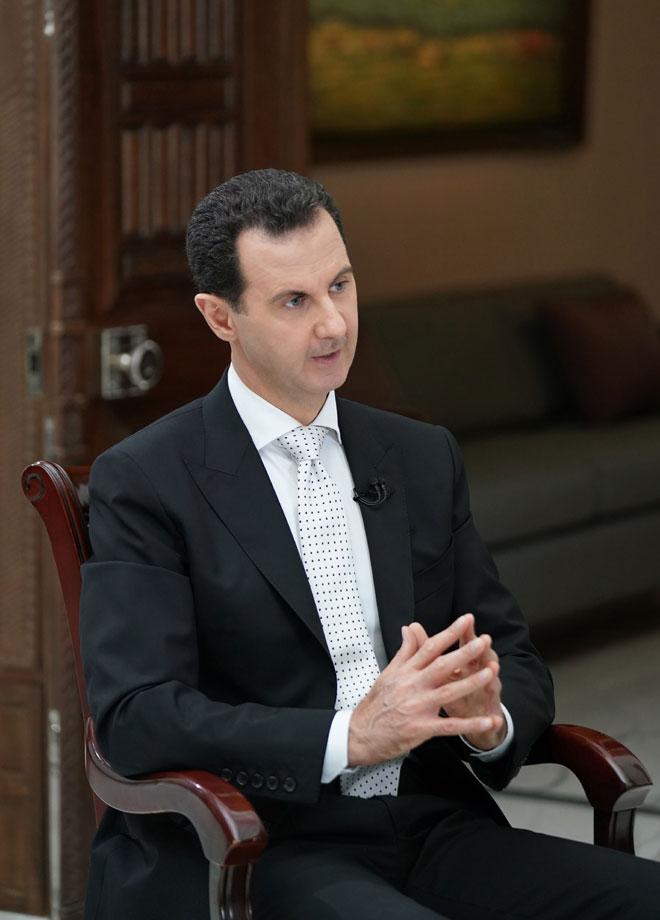
President Assad: If I don’t make mistakes, I’m not human; maybe on daily basis sometimes. The more you work, the more complicated the situation, the more mistakes you are likely to make. But how do you protect yourself from committing mistakes as much as possible? First of all, to consult the largest proportion of the people, not only the institutions, including the parliament, syndicates, and so on. But also the largest amount of this society, or the largest part of the society, to participate in every decision.
While if you talk about the way I behaved toward, or the way I led, let’s say, the government or the state during the war, the main pillars of the state’s policy were to fight terrorism – and I don’t think that fighting terrorism was wrong – to respond to the political initiatives from different parties externally and internally regardless of their intentions, to make a dialogue with everyone – including the militants, and finally to make reconciliation; I don’t think we can say that this was wrong. So, about the pillars of our policy, I think the reality has proven that we were right. About the details, of course, you always have mistakes.
Question 16: Now, how much is it going to cost to reconstruct this country, and who is going to pay for this?
President Assad: Hundreds of billions, the minimum is two hundred, and in some estimations it’s about four hundred billion dollars. Why it’s not precise? Because some areas are still under the control of the terrorists, so we couldn’t estimate precisely what is the number. So, this is plus or minus, let’s say.
Question 17: Now, there is a lot of speculation, people say in order for a political solution to be viable, you might have to sacrifice yourself for the good of the country, you know this, that kind of speculation. Is that something that crosses you mind?
President Assad: The main part of my future, as a politician, is two things: my will and the will of the Syrian people. Of course, the will of the Syrian people is more important than my will; my desire to be in that position or to help my country or to play a political role, because if I have that desire and will and I don’t have the public support, I can do nothing, and I will fail, and I don’t have a desire to fail. After seven years of me being in that position, if I don’t have the majority of the Syrian people’s support, how could I withstand for more than seven years now, with all this animosity by the strongest countries and by the richest countries? Who supports me? If the Syrian people are against me, how can I stay? How could I achieve anything? How could we withstand? So, when I feel that the Syrian people do not want me to stay anymore, of course I have to leave without any hesitation.
Question 18: But you know, there is a lot of blood that has, you know, taken place, and all that, so can you see yourself sitting across from the opposition and sharing, you know, power in some way?
President Assad: When you talk about blood, you have to talk about who created that blood. I was president before the war for ten years, had I been killing the Syrian people for ten years? No, definitely not. So, the conflict started because somebody, first of all part of the West, supported those terrorists, and they bear the responsibility for this war. So first of all the West, who provided military and financial support and political cover, and who stood against the Syrian people, who impoverished the Syrian people and created a better atmosphere for the terrorists to kill more Syrian people. So, part of the West – mainly France, UK, and US, and also Saudi Arabia and Qatar and Turkey are responsible for this part. It’s not enough to say there is blood; this is a very general term. Of course there is blood; it’s a war, but who’s responsible? Those who are responsible should be held accountable.
Question 19: Now, it’s been a few years since you visited Greece. Your father had a very close relation with some of the Greek political leaders. How have the relations been between Greece and Syria these days, and what kind of message would you like to send to the Greek people?

President Assad: At the moment, there are no formal relations between Syria and Greece; the embassies are closed, so there are no relations. At the same time, Greece wasn’t aggressive towards what happened in Syria. It always supported a political solution, it never supported war or attacks against Syria. You didn’t play any role to support the terrorists, but at the same time, as a member – and an important member – of the EU, you couldn’t play any role, let’s say, in refraining the other countries from supporting the terrorists, violating the international law by attacking and besieging a sovereign country without any reason, without any mandate by the Security Council. So, we appreciate that Greece wasn’t aggressive, but at the same time, I think Greece has to play that role, because it’s part of our region. It is part of the EU geographically, but it’s a bridge between our region and the rest of Europe, and it’s going to be affected, and it has been affected by the refugee situation, and the terrorism now has been affecting Europe for the last few years, and Greece is part of that continent. So, I think it’s normal for Greece to start to play its role in the EU in order to solve the problem in Syria and protect the international law.
Journalist: Thank you very much Mr. President.
President Assad: Thank you.