Πολιτική
The Usurpation of Properties in the Occupied Part of Cyprus

Speech by Oz Karahan
Spinelli 3G3, European Parliament
11 December 2024
Today, under the roof of the European Parliament, we will address the intertwining of transnational organized crimes and crimes against humanity that continue to occur in the occupied territories of the European Union.
By the end of the day, we will understand why the usurpation of Cypriot property in the occupied territory of Cyprus is not a “personal matter”, but a criminal conspiracy that concerns the entire world, including our state, the Republic of Cyprus, and the European Union, of which we are a part.
As Cypriots, we entered 2024 with a new matter. Akan Kürşat, a Turkish Cypriot lawyer, was arrested in Italy on a European Arrest Warrant related to the usurpation of Greek Cypriot properties.
This case was linked to Gary Robb, a British drug trafficker who built over three hundred luxury villas on land usurped in 2004.
In February 2024, the Union of Cypriots, in collaboration with the Green Party of Cyprus, issued statements urging the government of the Republic of Cyprus to promptly fulfill its duty. We called on the government to take decisive action and to pursue unity and joint efforts to address the illegal usurpation of Cypriot properties in the occupied areas.
However, the case against Akan Kürşat was closed with the excuse that “the only witness is dead.”
This decision had serious consequences.
Turkish and foreign companies breathed a sigh of relief and continued plundering the usurped properties in the occupied part of Cyprus.
Tens of thousands of housing projects were subsequently announced. In 2016, the highest number of housing units built in the occupied part of Cyprus was recorded, with just under seven thousand units. After Akan Kürşat was set free, a U.S.-based company alone launched a project for thirty thousand housing units, while a Turkish company initiated multiple projects totaling fourteen thousand units.
For those involved in the looting of property in the occupied areas, Article 303A, which was added to the relevant law in 2006, classifies the sale, rental, or even advertisement of usurped property in these territories as a criminal offense under the Criminal Code.
It is essential to underline that jurisdiction for this criminal offense lies with the Republic of Cyprus, as affirmed by the Court of Justice of the European Union. Furthermore, it is possible to issue a European Arrest Warrant or an international arrest warrant against those who commit this crime.
Despite this, Cypriot properties in the occupied part of Cyprus and the illegal real estate built on them continue to be marketed by companies based in European Union member states such as the Netherlands and Germany.
Meanwhile, the usurpers, mostly Turkish and Israeli construction companies, are selling these illegal properties at real estate expos held within the European Union.
This process has shown that if Article 303A, which was added to the relevant law in 2006 and punishes land usurpation with up to seven years’ imprisonment, had been enforced in time, the looting in the occupied part of Cyprus could have been prevented. Yet, it is still not too late, and many avenues of struggle remain.
In Cyprus, we face daily examples of how the usurpation of properties in the occupied part of the island is intertwined with transnational organized crime. The latest instance appeared in the news last week and involves a pending case in Larnaca concerning a Bulgarian citizen who is sought for extradition by Georgia. According to reports, his case involves drug trafficking, money laundering, and the usurpation of properties in the occupied part of Cyprus. We know that the cases appearing in the media represent just the tip of the iceberg of those concerning not only Cyprus but also European Union institutions.
Today, the usurpation of property in the occupied part of Cyprus continues, also complicating the resolution of the Cyprus problem itself. The increasing number of illegal settlers and the presence of forty thousand occupying troops have turned Turkish Cypriots into a minority in the occupied part of Cyprus.
In other words, the influx of illegal settlers and settlements, as well as the presence of occupying soldiers, creates problems for both Greek Cypriots and Turkish Cypriots.
According to figures provided by the official responsible for population transfer under the occupation regime at the time, between 1975 and 1979, a total of 82,500 settlers from Turkey were brought in during the initial phase. At that time, the number of native Turkish Cypriots living in the occupied region of Cyprus was approximately 110,000. In other words, immediately after the occupation, the number of settlers from Turkey was nearly equal to the number of Turkish Cypriots.
Turkish Cypriot politicians and intellectuals who opposed these actions, such as Kutlu Adalı, were targeted by the Turkish occupation regime. Due to ongoing political, cultural, and economic oppression, many Turkish Cypriots left the island and emigrated to other countries.
In 2011, the statistical agency of the occupation regime reported the number of native Cypriots living in the occupied area as one hundred twenty thousand. This figure was confirmed in 2016 when President Nicos Anastasiades stated that one hundred seventeen thousand Turkish Cypriots held Cypriot citizenship. In January 2024, the union of muhtars, who maintain records of residents in neighborhoods, the smallest administrative unit in the occupied part of Cyprus, reported that the population in the occupied part of Cyprus exceeds one million. This figure is further corroborated by data from the so-called institutions of the occupied area, including increases in the number of housing units, registered vehicles, and GSM operator subscribers.
In the United Nations demilitarized zone of Nicosia, Cypriot political party representatives, consisting of both Turkish Cypriots and Greek Cypriots, have been meeting since 1989, initially under the auspices of the Czechoslovak Embassy, and later continued by the Slovak Embassy. In September this year, the Green Party of Cyprus hosted a meeting titled “Ending Usurpation of Greek Cypriot Properties as a Crucial Confidence-Building Measure to Enhance the Solution to the Cyprus Problem.”
The final communiqué of this meeting, agreed upon by representatives of both Greek Cypriot and Turkish Cypriot political parties and dated September 25, 2024, stated that the usurpation of properties in the occupied part of Cyprus “affects fundamental human rights, tends to eliminate restitution — namely, as one of the agreed remedies for the property issue, thus deteriorating the nature of the solution to the Cyprus problem and the daily life of all Cypriots.”
Settler colonialism constitutes war crimes and crimes against humanity under the 1949 Geneva Conventions and the 1998 Rome Statute of the International Criminal Court. As the occupying power, Turkey is transferring populations to alter the demographic structure of Cyprus. This crime is not subject to any statute of limitations under international law, as affirmed by the 1968 United Nations Convention on the Non-Applicability of Statutory Limitations to War Crimes and Crimes Against Humanity.
I ask you: how can a country remain occupied for fifty years?
The answer lies in the elimination of the indigenous population and the usurpation of their land. This is a crime against humanity known as settler colonialism.
A case addressing settler colonialism and Turkey’s crimes in Cyprus is now before the International Criminal Court. Costas Mavrides, a Member of the European Parliament who is present here today, took a historic initiative in 2014 to bring Turkey’s war crimes in Cyprus to the ICC.
On June 15, 2021, ICC Prosecutor Fatou Bensouda referred this case to her successor, Karim Khan, for a decision. We hope Prosecutor Karim Khan will show the same dedication to Cyprus as he has to the events in neighboring Palestine, which is also a victim of settler colonialism.
Meanwhile, foreign interventions in the sovereignty of the Republic of Cyprus continue — not only by Turkey. Reports indicate that Israeli President Isaac Herzog intervened with Cypriot President Nicos Christodoulides regarding the arrest of Simon Mistriel Aykut, a citizen of Israel, Turkey, and Portugal. It is appalling that the leader of a country responsible for the same crimes as Turkey would attempt to interfere another nation’s legal process on behalf of a land usurper.
We are aware that, given the circumstances in Cyprus where an ongoing occupation persists, it is maybe difficult for our state to obtain the hard evidence necessary to address cases of property usurpation. Therefore, in August 2024, we published the names of dozens of companies and their owners involved in the usurpation of property in the occupied areas of Cyprus. We also publicized these actions to assist our state institutions in taking the necessary measures. Because it is deeply troubling to citizens that these usurpers, along with the politicians and institutions that support them, are still able to access areas controlled by the Republic of Cyprus or travel to Europe for business and other purposes. As Cypriot citizens, we expect our state, as well as the European Union and its institutions, to take meaningful action after half a century of these ongoing crimes.
I would also like to emphasize that the struggle against occupation and settler colonialism must include calls for sanctions, embargoes, and boycotts. This approach was recently articulated in the “Declaration of Pan-Cyprian Mobilization for the Freedom of Cyprus”, signed by hundreds of intellectuals, academics, journalists, and active Cypriot citizens from all backgrounds. We must employ all legal, political, and economic tools to combat Turkey’s ongoing crimes in Cyprus. The institutions of both our state and the European Union must take action, and we, as Cypriots, will continue to pressure them to fulfill their responsibilities.
Finally, the claim that “the usurpation of property in the occupied part of Cyprus will be resolved with the Cyprus problem” is not just wrong and ineffective but also destructive. For Cypriots, the Cyprus problem is not an intercommunal political issue, as some try to frame it. It is a problem of occupation and colonization. It is also shameful when those who argue that the Cyprus issue is merely a political dispute between two communities suggest that solving it is the only way to prevent crimes against humanity. Ending crimes against humanity cannot and should not depend on the resolution of a political problem.
It is also appalling that advocates of this shameful idea, who are effectively whitewashing crimes against humanity, propose apartheid-like political solutions to the Cyprus problem. Such proposals would allow Turkey to evade accountability for its crimes, including settler colonization and land usurpation.
As I mentioned at the beginning, the Turkish occupation today is intertwined with crimes against humanity, widespread human rights violations, and transnational organized crime. Addressing these issues urgently and seriously is a duty for all of us.
Cypriots, like any other nation in the world, deserve to live in their homeland in peace, security, and with the dignity every human deserves.
- Speech by Aziz Şah
The Usurpation of Properties in the Occupied Part of Cyprus
Spinelli 3G3, European Parliament
11 December 2024
I am here as a journalist from the part of Cyprus that has been under Turkish occupation since 1974. Turkey has occupied 37% of the sovereign territory of the Republic of Cyprus. To perpetuate this occupation, it has systematically committed crimes under the Geneva Convention and the Rome Statute.
 The first of these crimes is the “crime of forced displacement and settler population transfer.”
The second is “the crime of unlawful and arbitrary destruction and seizure of property.”
What do the war crimes and crimes against humanity that Turkey has systematically committed in Cyprus for half a century mean for humanity?
Crimes that go unpunished are repeated!
Article 49 of the 1949 Geneva Convention states that “The Occupying Power shall not deport or transfer parts of its own civilian population into the territory it occupies.” I would like to remind you that this article was written to prevent a repeat of the colonization policies pursued by the Nazis in the territories they occupied during the Second World War.
For 50 years, Turkey has been trampling on international law in Cyprus, including the European Convention on Human Rights, the Hague Conventions, the Geneva Convention, the Rome Statute, and the Convention on the Non-Applicability of Statutory Limitations to War Crimes and Crimes Against Humanity.
 The basis of Turkey’s usurpation of land in Cyprus is the construction of settlements and the transfer of population to the occupied territory, which are war crimes according to the Geneva Convention and the Rome Statute.
However, the issue does not stop with these war crimes:
There are two other pillars of land usurpation: “money laundering,” defined as a transnational organized crime, and “infiltration of legal business to launder money.” Both are directly linked to land usurpation.
Building on usurped land is part of the trafficking-drugs-money laundering cycle.
Cypriot journalists have also documented construction companies brokering human trafficking from Asia and Africa. Cyprus ranks first in the European Union for first-time asylum seekers per capita. The Purnara Refugee Camp in the Republic of Cyprus is overcrowded with migrants who were brought to the occupied territory under the guise of being “workers.”
Black money in the occupied part of Cyprus enters the world and EU market through shell companies.
In 2024, five individuals were prosecuted in the courts of the Republic of Cyprus for land usurpation and money laundering crimes, following complaints by Cypriot refugees who were expelled from their homes in 1974. There are hundreds more predatory construction and real estate companies that have committed crimes.
The most prominent of these detainees is Simon Mistriel Aykut, a Turkish citizen (who also holds Israeli and Portuguese citizenship) and director of the AFIK construction company.
Apart from Aykut, an Israeli, two Hungarian, and a German real estate agent have also been indicted for usurpation and money laundering following complaints by Cypriot refugees.
Land usurpation in Cyprus does not only concern Cypriots.
The usurpation cases also affect the German and Hungarian states and the EU, because the usurped properties were sold and advertised through Hungarian and German real estate companies.
Was the money from these illegal transactions in the occupied part of Cyprus transferred to Germany and Hungary? If so, how?
These simple questions alone show that the issue of land usurpation in the occupied part of Cyprus is an EU issue as well.
The case of Simon Mistriel Aykut, the director of the AFIK company, who committed war crimes and usurped individual property rights by building settlements on the land of refugees expelled at gunpoint in 1974, is even more complex. AFIK, the company that committed the crime of land usurpation in Cyprus, also operates in Germany, Greece, Turkey, and Israel. According to documents published by Cypriot journalists, the Aykut family also owns companies in the Cayman Islands, the Netherlands, and the Republic of Cyprus.
Land usurpation in Cyprus is a serious transnational crime for the EU. The settlements built on the usurped land are funded with black money of unknown origin. These properties are marketed worldwide, including in Europe, by Russian, Iranian, Israeli, German, British, Hungarian, and Eastern European real estate agents and companies.
This is similar to the illegal settlements in the West Bank, and potentially Gaza in the future, that are being marketed by European companies.
The settlement policies of Turkey and Israel in the occupied territories are similar. This is also evident in United Nations resolutions:
For Cyprus, Resolutions 33/15 (1978), 34/30 (1979), 37/253 (1983), 4 (XXXII) (1976), and 1987/50 (1987) state that “changes in the demographic structure of Cyprus continue with the influx of large numbers of settlers” and argue that “all unilateral actions changing the demographic structure” obstruct the return of refugees and all displaced persons to their homes.
For Israel, Resolutions 446 (1979), 452 (1979), 465 (1980), and 2234 (2015) call on it to “cease illegal settlement construction in violation of the Fourth Geneva Convention, which is an obstacle to peace.”
Criticizing Israel’s settlement policy in the occupied Palestinian territories, Turkish Foreign Minister Hakan Fidan recently said:
“You (Israel) are occupying someone’s land. You’re seizing their home, throwing them out, bringing somebody (else) in, and calling them ‘settlers.’ This is called theft.”
When Fidan criticizes Israel’s settler colonialism, he is describing the very crime of destruction of property and land usurpation that Turkey has perpetuated in occupied Cyprus for the past 50 years.
Indeed, as Hakan Fidan states, settler colonialism is theft.
In summary, it is essential to understand that, in addition to war crimes, land usurpation in Cyprus constitutes part of “transnational organized crime,” defined by the UN in 1994 to include crimes such as “terrorist acts, human trafficking, and arms and drug trafficking.”
So, what is the political motivation behind Turkey’s settlement construction carried out through real estate and construction companies?
Turkey’s policy of land usurpation aims to permanently undermine any settlement in Cyprus based on the EU Charter of Fundamental Rights and the EU acquis.
After 1974, Turkey systematically established a racist apartheid regime. First, Greek Cypriots, Maronites and Armenians were expelled from their homes. In 1975, the Turkish Ministry of Foreign Affairs issued a “directive” to move settlers to Cyprus. According to this directive, “families resettled in Cyprus must be Turkish citizens and their mother tongue must be Turkish.” Settler colonization seeks to Turkify Cyprus.
When Turkey began illegally settling people in the occupied part of Cyprus in 1975, the properties were not empty. Approximately 20,000 Greek Cypriots had remained in their homes. After 50 years of ethnic cleansing, only about 300 remain today.
In 1995, the occupation regime enacted the “Settlement, Land Distribution, and Equivalent Property (ITEM) Law,” paving the way for the sale and construction on usurped land. The construction boom accelerated after 1995.
The transformation continued with the negotiation of the Annan Plan for the settlement of the Cyprus problem between 2001 and 2004. According to the Annan Plan, the usurpers would have priority over the original owners. Although the plan was rejected, the occupation regime continues to use it as a basis for land usurpation.
A total of 694 houses were built in the occupied part of Cyprus in 1993. In 2003, with the Annan Plan, this number doubled to 1,354. In 2013, 2,882 houses were built and in 2023 this number will rise to 4,141. The construction boom continues exponentially…
Land grabbing in a country occupied by a foreign power is not a “personal matter” for refugees to solve on their own.
According to international law, occupation is a temporary situation, the occupation regime cannot have permanent effects on immovable property. Private property cannot be usurped. Permanent settlements cannot be established to change the status of land.
Many Cypriot refugees have brought individual cases before the European Court of Human Rights. The Court could not cope with the burden of these cases. As a result, the Immovable Property Commission under the occupation regime was established 19 years ago following a ruling by the European Court of Human Rights.
According to the Commission’s statement, as of November 29, 2024, a total of 7,849 applications had been submitted, of which 1,892 had been evaluated.
This means that out of approximately 170,000 refugees, only 1,892 files were evaluated in 19 years!
Moreover, the Immovable Property Commission awards a maximum of one-tenth of the property’s value as compensation. These compensations often go unpaid for years. This is because, for a Commission decision to be implemented, it must be signed and accepted by an official of the occupation regime. Files remain pending for years without a signature, further exacerbating the victimization of refugees.
The Immovable Property Commission has become part of the problem, not the solution. Because the occupation regime and the European Court of Human Rights do not have the same goal in the property issue.
Beyond solving the problem, the Immovable Property Commission has caused an avalanche of land looting. The establishment of the Commission was a guarantee for the usurpers. Realizing that they would be able to get away with the property they usurped without paying any price, the companies accelerated their land looting.
Today, the Immovable Property Commission is being used as a weapon against refugees. Because Cypriot refugees were prevented from even filing a compensation case at the European Court of Human Rights, the usurpers were relieved. This is also a violation of human rights: According to Article 34 of the European Convention on Human Rights, the effective exercise of the right to apply to the European Court of Human Rights cannot be prevented in any way.
The right of return of refugees and their descendants is a right recognized by the Universal Declaration of Human Rights and the Fourth Geneva Convention.
The transfer of Cypriot refugees’ property cases by the European Court of Human Rights to the Immovable Property Commission in the occupation regime has emboldened land usurpation.
It is unacceptable that refugees are left alone on the grounds that “property is a personal matter”. Refugees lost their property in the war… Land usurpation in Cyprus is not a “personal matter”. It is an occupying power altering the status of land and the identity of a country, which constitutes a war crime and is part of transnational organized crime, including money laundering.
Georghios M. Pikis of Cyprus, a founding judge of the International Criminal Court (ICC) and the first President of its Appeals Chamber, served from 2003 to 2009 after the Court was established under the Rome Statute to prosecute war crimes and crimes against humanity. In a conference on the ICC, he stated:
“Without justice there can be no peace and without peace, human existence is left at the mercy of the ill passions of the strong for power, domination, riches and sequential inhuman acts.”
As Cypriots, we want the International Criminal Court to work for Cyprus. The human rights of Cypriots cannot be left at the mercy of the occupier. The plundered land and usurped human rights belong to all Cypriots.
“There can be no peace without justice.”






GEOPOLITICO
Νέα τουρκική πρόκληση νότια του Καστελλόριζου! NAVTEX της Άγκυρας στην περιοχή που θα περάσει το γαλλικό ερευνητικό για το καλώδιο Ελλάδας–Κύπρου
Η Άγκυρα εξέδωσε NAVTEX για περιοχή νότια του Καστελλόριζου, όπου έχει προγραμματιστεί η πολυεθνική άσκηση «EUNOMIA», αμφισβητώντας τη δικαιοδοσία του Σταθμού Ηρακλείου. Η κίνηση αποκτά ιδιαίτερη σημασία καθώς βρίσκεται σε εξέλιξη η διαδικασία για την επανέναρξη των ερευνών της ηλεκτρικής διασύνδεσης Ελλάδας–Κύπρου, με το γαλλικής σημαίας πλοίο «Abeille Marengo».

Νέο επεισόδιο στον ανταγωνισμό για τις θαλάσσιες αρμοδιότητες στην Ανατολική Μεσόγειο προκαλεί η Τουρκία, αυτή τη φορά σε περιοχή από την οποία προβλέπεται να διέλθει το ερευνητικό σκάφος που θα πραγματοποιήσει εργασίες για το υποθαλάσσιο καλώδιο Ελλάδας–Κύπρου.
Ο τουρκικός Σταθμός Αττάλειας εξέδωσε ναυτική αγγελία, αμφισβητώντας την αρμοδιότητα του ελληνικού Σταθμού Ηρακλείου σε θαλάσσια περιοχή νότια του Καστελλόριζου.
Η τουρκική ενέργεια σημειώθηκε λίγες ώρες μετά την έκδοση ελληνικής NAVTEX, με την οποία δεσμεύτηκε η συγκεκριμένη θαλάσσια περιοχή για τη διεξαγωγή της πολυεθνικής άσκησης πυρών «EUNOMIA», στις 19 Οκτωβρίου.
Η Άγκυρα απάντησε εκδίδοντας δική της NAVTEX, υποστηρίζοντας ότι η περιοχή εμπίπτει στη δική της ζώνη ευθύνης για την έκδοση ναυτικών αγγελιών.
Μάλιστα, προχώρησε στην επανέκδοση της αγγελίας για τη συμμαχική άσκηση, χρησιμοποιώντας ακριβώς τις ίδιες συντεταγμένες που είχαν περιληφθεί στην ελληνική ανακοίνωση.
Η κίνηση αυτή δεν αφορά την πραγματοποίηση διαφορετικής τουρκικής άσκησης, αλλά τη διεκδίκηση της αρμοδιότητας έκδοσης της σχετικής ναυτικής προειδοποίησης.
Το γαλλικό ερευνητικό και η επανεκκίνηση του Great Sea Interconnector
Το περιστατικό αποκτά ευρύτερη γεωπολιτική διάσταση καθώς συνδέεται χρονικά και γεωγραφικά με την προετοιμασία για την επανέναρξη των εργασιών του Great Sea Interconnector.
Πρόκειται για το έργο ηλεκτρικής διασύνδεσης Κρήτης–Κύπρου, το οποίο προβλέπει την εγκατάσταση υποθαλάσσιου καλωδίου υψηλής τάσης συνεχούς ρεύματος 500 kV.
Στις 14 Οκτωβρίου, η γαλλική Nexans, ανάδοχος του καλωδίου, προχώρησε στις απαραίτητες ενέργειες για την έκδοση NAVTEX, ενώ παράλληλα βρίσκεται σε εξέλιξη η διαδικασία έγκρισης της συμμετοχής του γαλλικής σημαίας ερευνητικού πλοίου «Abeille Marengo».
Το συγκεκριμένο πλοίο πρόκειται να πραγματοποιήσει προκαταρκτικές υποθαλάσσιες έρευνες στη διαδρομή μεταξύ της Κορακιάς Ηρακλείου και της Κύπρου.
Οι εργασίες περιλαμβάνουν τη χαρτογράφηση του βυθού, την εξέταση της μορφολογίας του και τον προσδιορισμό της καταλληλότερης όδευσης για την τοποθέτηση των καλωδίων.
Η περιοχή νότια του Καστελλόριζου, στην οποία εκδηλώθηκε η νέα τουρκική αμφισβήτηση, περιλαμβάνεται στη σχεδιαζόμενη πορεία του ερευνητικού.
Δεν έχει, ωστόσο, ανακοινωθεί ακόμη οριστική ημερομηνία έναρξης των νέων ερευνών.
Το έγγραφο του Λιμενικού και η προθεσμία της 16ης Οκτωβρίου
Ιδιαίτερο ενδιαφέρον παρουσιάζει το έγγραφο του Αρχηγείου του Λιμενικού Σώματος, με ημερομηνία 14 Οκτωβρίου 2026, το οποίο αφορά την αίτηση εξαίρεσης για τη χρήση του γαλλικού πλοίου.
Σύμφωνα με το έγγραφο, το αίτημα είχε υποβληθεί στις 9 Οκτωβρίου από το ναυτικό πρακτορείο «Δ. Πατρίκιος ΙΚΕ», για λογαριασμό της ιταλικής Next Geosolutions Europe SpA.
Η ιταλική εταιρεία έχει αναλάβει τις προκαταρκτικές υποθαλάσσιες έρευνες για λογαριασμό της Nexans.
Η χρησιμοποίηση πρόσθετου ερευνητικού σκάφους κρίθηκε απαραίτητη εξαιτίας των ιδιαίτερα απαιτητικών τεχνικών χαρακτηριστικών της προβλεπόμενης όδευσης.
Συγκεκριμένα, οι εργασίες θα πραγματοποιηθούν σε περιοχές μεγάλου βάθους, με απότομες υποθαλάσσιες πλαγιές και γεωμορφολογικά χαρακτηριστικά που απαιτούν εξειδικευμένο εξοπλισμό.
Το Λιμενικό κάλεσε τις αρμόδιες λιμενικές αρχές και τους ναυτιλιακούς φορείς να διερευνήσουν εάν υπάρχουν διαθέσιμα πλοία ελληνικής σημαίας με αντίστοιχες δυνατότητες.
Η προθεσμία για την υποβολή των σχετικών απαντήσεων λήγει σήμερα, Παρασκευή 16 Οκτωβρίου, στις 13:00.
Το έγγραφο κοινοποιήθηκε, μεταξύ άλλων, στο υπουργείο Εξωτερικών και στο Γενικό Επιτελείο Ναυτικού.
Οι έρευνες έχουν παράταση έως τις 31 Δεκεμβρίου 2026
Σημαντική λεπτομέρεια αποτελεί το γεγονός ότι οι υποθαλάσσιες έρευνες είχαν αρχικά εγκριθεί από το υπουργείο Εξωτερικών τον Ιούνιο του 2024.
Με νεότερη απόφαση, τον Φεβρουάριο του 2026, δόθηκε παράταση της σχετικής έγκρισης έως τις 31 Δεκεμβρίου 2026.
Η επανέναρξη των εργασιών προϋποθέτει την ολοκλήρωση των απαιτούμενων διαδικασιών, ενώ προβλέπεται ενημέρωση της Υδρογραφικής Υπηρεσίας και της Διοίκησης Υποβρυχίων του Πολεμικού Ναυτικού τουλάχιστον 72 ώρες πριν από την έναρξη των ερευνών.
Η επίσημη ανακοίνωση του Λιμενικού επιβεβαιώνει την υποβολή αίτησης για τη χρησιμοποίηση του «Abeille Marengo», χωρίς αυτό να σημαίνει ότι έχει ήδη δοθεί η τελική έγκριση ή ότι το πλοίο έχει ξεκινήσει τις εργασίες του.
Η «EUNOMIA» και το γεωπολιτικό μήνυμα στην Ανατολική Μεσόγειο
Η πολυεθνική άσκηση «EUNOMIA» πραγματοποιείται στο πλαίσιο της συνεργασίας Ελλάδας, Κύπρου, Γαλλίας και Ιταλίας για τη σταθερότητα και την ασφάλεια στην Ανατολική Μεσόγειο.
Σύμφωνα με τις δημοσιευμένες πληροφορίες, το πρόγραμμα δραστηριοτήτων εκτείνεται από τις 16 έως τις 22 Οκτωβρίου, με επιπλέον δραστηριότητα στις 26 Οκτωβρίου. Η συγκεκριμένη NAVTEX που επικαλείται το Liberal αφορά άσκηση πυρών στις 19 Οκτωβρίου.
Η τουρκική παρέμβαση αποκτά ιδιαίτερη σημασία επειδή σημειώνεται σε περιοχή που συνδέεται με τον σχεδιασμό ενός ευρωπαϊκού ενεργειακού έργου.
Η Άγκυρα δεν αμφισβητεί απλώς μια ναυτική ανακοίνωση. Επαναφέρει τη διεκδίκησή της περί αρμοδιότητας έκδοσης NAVTEX σε μια θαλάσσια ζώνη όπου η ελληνική πλευρά προετοιμάζει δραστηριότητες που αφορούν την ηλεκτρική διασύνδεση.
Πρέπει, ωστόσο, να διακρίνεται η αρμοδιότητα έκδοσης ναυτικών αγγελιών από την οριοθέτηση υφαλοκρηπίδας και ΑΟΖ. Πρόκειται για διαφορετικά νομικά ζητήματα και η έκδοση μιας NAVTEX δεν καθορίζει από μόνη της κυριαρχικά δικαιώματα.
Το κρίσιμο τεστ για την Αθήνα: Τι θα συμβεί όταν φτάσει το γαλλικό σκάφος;
Το πραγματικό ενδιαφέρον πλέον μετατοπίζεται στην επόμενη φάση.
Όταν ολοκληρωθεί η αδειοδότηση και εκδοθεί η NAVTEX για τις έρευνες του «Abeille Marengo», θα διαπιστωθεί εάν η Τουρκία περιοριστεί σε νέα αμφισβήτηση μέσω ναυτικών αγγελιών ή προχωρήσει σε άλλες ενέργειες.
Το προηγούμενο των εντάσεων γύρω από τις έρευνες για το καλώδιο καθιστά το συγκεκριμένο ερώτημα ιδιαίτερα σημαντικό για την Αθήνα και τη Λευκωσία.
Επιπλέον, η συμμετοχή γαλλικής εταιρείας και πλοίου γαλλικής σημαίας προσδίδει στο θέμα ευρωπαϊκή διάσταση, χωρίς να συνεπάγεται αυτομάτως στρατιωτική ή διπλωματική αντίδραση του Παρισιού.
Η απάντηση θα εξαρτηθεί από την εξέλιξη των εργασιών και τις αποφάσεις των εμπλεκόμενων κυβερνήσεων.
Η ουσία είναι ότι το Great Sea Interconnector επανέρχεται στο επίκεντρο της ελληνοτουρκικής αντιπαράθεσης πριν ακόμη αρχίσουν οι νέες έρευνες.
Η ελληνική πλευρά έχει ενεργοποιήσει τη διαδικασία για την επιστροφή του ερευνητικού σκάφους στη θάλασσα. Η Τουρκία, από την πλευρά της, επέλεξε να επαναφέρει την αμφισβήτηση της αρμοδιότητας του Ηρακλείου με αφορμή την άσκηση «EUNOMIA».
Το επόμενο διάστημα θα δείξει εάν οι νέες έρευνες θα προχωρήσουν χωρίς παρεμπόδιση ή εάν το καλώδιο Ελλάδας–Κύπρου θα αποτελέσει ξανά πεδίο έντασης στην Ανατολική Μεσόγειο.
GEOPOLITICO
«Ελευθερία» Λονδίνου: Αδιέξοδο στο Κυπριακό, νέα εποχή στις σχέσεις Βρετανίας–ΕΕ και τα μηνύματα Ρούμπιο προς την Τουρκία
Στο επίκεντρο του νέου φύλλου της ομογενειακής εφημερίδας η αμετακίνητη στάση της τουρκικής πλευράς στο Κυπριακό, οι πολιτικές εξελίξεις στο Ηνωμένο Βασίλειο και η ερμηνεία της επίσκεψης του Αμερικανού υπουργού Εξωτερικών στην Αθήνα από τον τουρκικό Τύπο. Ξεχωριστή θέση κατέχουν η 66η επέτειος της Κυπριακής Ανεξαρτησίας και η δυναμική παρουσία των Ελληνοκυπρίων στη βρετανική αυτοδιοίκηση.
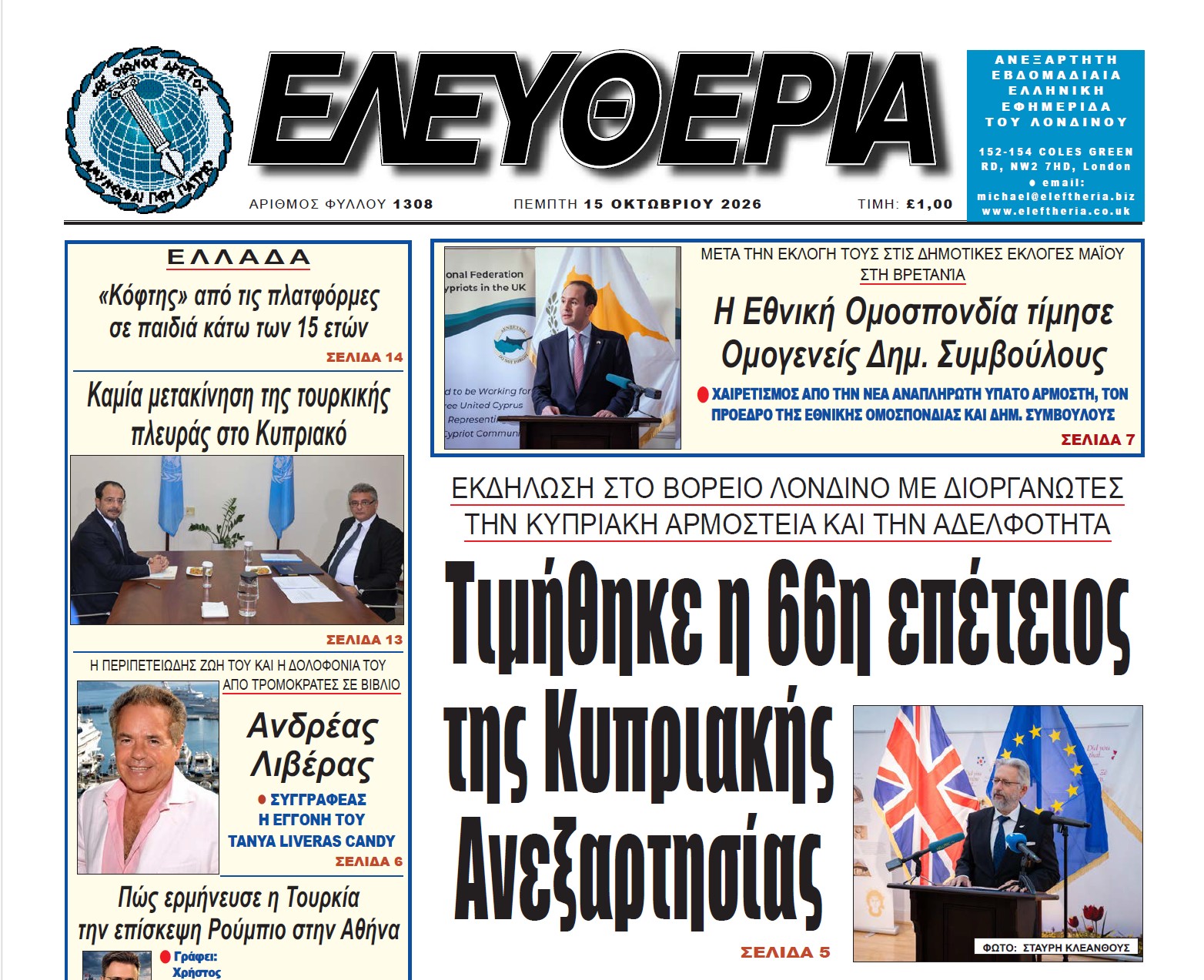
Με πλούσια θεματολογία γύρω από τις διεθνείς εξελίξεις, το Κυπριακό, τις ελληνοαμερικανικές σχέσεις και τη δραστηριότητα της ελληνικής και κυπριακής ομογένειας κυκλοφόρησε την Πέμπτη 15 Οκτωβρίου 2026 το 1308ο φύλλο της εβδομαδιαίας εφημερίδας «Ελευθερία» του Λονδίνου.
Η έκδοση αναδεικνύει τις διπλωματικές εξελίξεις στην Ανατολική Μεσόγειο, τις προσπάθειες επαναπροσέγγισης του Ηνωμένου Βασιλείου με την Ευρωπαϊκή Ένωση, αλλά και τον ενεργό ρόλο του απόδημου ελληνισμού στη δημόσια ζωή της Βρετανίας.
Κυπριακό: Καμία ουσιαστική μετακίνηση από την τουρκική πλευρά
Ένα από τα κεντρικά πολιτικά θέματα της εφημερίδας αφορά τη συνάντηση του Προέδρου της Κυπριακής Δημοκρατίας Νίκου Χριστοδουλίδη με τον Τουρκοκύπριο ηγέτη Τουφάν Ερχιουρμάν.
Με τίτλο «Καμία μετακίνηση της τουρκικής πλευράς στο Κυπριακό», η «Ελευθερία» επισημαίνει ότι οι δύο πλευρές συμφώνησαν σε περιορισμένης σημασίας ζητήματα, χωρίς να σημειωθεί ουσιαστική πρόοδος στον πυρήνα του προβλήματος.
Οι συμφωνίες αφορούν την κοινή παρουσία των δύο ηγετών στο 6ο Δικοινοτικό Φεστιβάλ Ειρήνης στην Πύλα, τη συμμετοχή τους σε συνεδριάσεις τεχνικών επιτροπών και τον προγραμματισμό νέας συνάντησης.
Ωστόσο, σύμφωνα με την εφημερίδα, η τουρκική πλευρά εξακολουθεί να θέτει ως προϋπόθεση για την επανέναρξη των ουσιαστικών συνομιλιών την αποδοχή της λεγόμενης «κυριαρχικής ισότητας».
Το δημοσίευμα στρέφει επίσης την προσοχή στην επικείμενη επίσκεψη της προσωπικής απεσταλμένης του Γενικού Γραμματέα του ΟΗΕ, Μαρίας Άνχελα Ολγκίν, και στο ερώτημα αν θα μπορέσει να επανεκκινήσει η διαπραγματευτική διαδικασία πριν ολοκληρωθεί η θητεία του Αντόνιο Γκουτέρες.
Η επίσκεψη Ρούμπιο στην Αθήνα και η αντίδραση του τουρκικού Τύπου
Ξεχωριστή θέση στην έκδοση καταλαμβάνει το άρθρο του δημοσιογράφου Χρήστου Κωνσταντινίδη, με τίτλο «Πώς ερμήνευσε η Τουρκία την επίσκεψη Ρούμπιο στην Αθήνα», το οποίο εξετάζει τον τρόπο με τον οποίο τα τουρκικά μέσα ενημέρωσης αντιμετώπισαν τα μηνύματα του Αμερικανού υπουργού Εξωτερικών.
Η ομιλία του Μάρκο Ρούμπιο στην Πνύκα και η προβολή της Ελλάδας ως στρατηγικού εταίρου των Ηνωμένων Πολιτειών αποτέλεσαν αντικείμενο σχολιασμού από τουρκικές εφημερίδες και αναλυτές.
Στο επίκεντρο βρίσκονται η αμερικανική στρατηγική στην Ανατολική Μεσόγειο, η ελληνοαμερικανική αμυντική συνεργασία, η ενεργειακή ασφάλεια και η στάση της Ουάσινγκτον απέναντι στις ελληνοτουρκικές διαφορές.
Σε άλλη παρέμβαση της έκδοσης, ο ακαδημαϊκός Αυγουστίνος Αυγουστή θέτει το ερώτημα κατά πόσο οι θετικές δηλώσεις της αμερικανικής πλευράς συνοδεύονται από συγκεκριμένες δεσμεύσεις για τα ελληνικά και κυπριακά συμφέροντα.
Βρετανία και Ευρωπαϊκή Ένωση: Ανοίγει η συζήτηση για υπέρβαση του Brexit
Στο βρετανικό μέτωπο, η «Ελευθερία» αφιερώνει εκτενές δημοσίευμα στην προσπάθεια της κυβέρνησης του Άντι Μπέρναμ να διαμορφώσει μια νέα σχέση με τις Βρυξέλλες.
Ο Βρετανός πρωθυπουργός εμφανίζεται να θεωρεί ανεπαρκές το σημερινό πλαίσιο συνεργασίας, υποστηρίζοντας ότι το Brexit προκάλεσε μεγαλύτερη οικονομική ζημιά από τα αναμενόμενα οφέλη.
Η εφημερίδα αναφέρεται στην προγραμματισμένη για τις 20 Νοεμβρίου σύνοδο κορυφής Ευρωπαϊκής Ένωσης–Ηνωμένου Βασιλείου στις Βρυξέλλες, όπου αναμένεται να εξεταστούν νέες συμφωνίες για το εμπόριο, την κινητικότητα των νέων και την οικονομική συνεργασία.
Στη συζήτηση περιλαμβάνονται ακόμη η πιθανότητα στενότερης σύνδεσης της Βρετανίας με την ενιαία αγορά και την τελωνειακή ένωση, καθώς και οι προοπτικές μιας νέας συζήτησης για την ευρωπαϊκή πορεία της χώρας μετά τις επόμενες γενικές εκλογές.
Ουκρανία και Ιράν: Αμυντική συνεργασία και ζητήματα ασφάλειας
Στη διεθνή επικαιρότητα, η εφημερίδα παρουσιάζει τη συνάντηση του Βρετανού πρωθυπουργού με τον Ουκρανό πρόεδρο Βολοντίμιρ Ζελένσκι στο Λονδίνο.
Σύμφωνα με το δημοσίευμα, βασικά θέματα των συνομιλιών αποτέλεσαν η ενίσχυση της ουκρανικής αεράμυνας, η διάθεση νέων πυραυλικών συστημάτων και η αντιμετώπιση των ρωσικών μη επανδρωμένων αεροσκαφών.
Παράλληλα, καταγράφονται οι βρετανικές ανησυχίες για πιθανή ιρανική εμπλοκή σε περιστατικό ασφαλείας στη στρατιωτική βάση RAF Fairford, που χρησιμοποιείται από τις αμερικανικές ένοπλες δυνάμεις. Η εφημερίδα αποδίδει στον Μπέρναμ την εκτίμηση ότι η εμπλοκή των Φρουρών της Επανάστασης είναι «σχεδόν βέβαιη».
Η ομογένεια τίμησε την Κυπριακή Ανεξαρτησία
Ιδιαίτερη βαρύτητα δίνεται και στην 66η επέτειο της ανακήρυξης της Κυπριακής Ανεξαρτησίας.
Η εφημερίδα καταγράφει την επετειακή εκδήλωση που διοργάνωσαν στο βόρειο Λονδίνο η Κυπριακή Υπάτη Αρμοστεία και η Ελληνική Κυπριακή Αδελφότητα Λονδίνου, παρουσία διπλωματών, εκπροσώπων της Εκκλησίας, της βρετανικής αυτοδιοίκησης και της ομογένειας.
Ο Ύπατος Αρμοστής Κυριακός Κούρος αναφέρθηκε στη σημασία διατήρησης της ιστορικής μνήμης, στην ανάγκη τερματισμού της τουρκικής κατοχής και στη συμβολή της κυπριακής παροικίας στην ενημέρωση της βρετανικής κοινωνίας για το Κυπριακό.
Στην εκδήλωση μίλησαν επίσης ο πρόεδρος της Αδελφότητας Φάνος Θεοφάνους και η δήμαρχος Μπάρνετ Zahra Beg, η οποία περιέγραψε τις εντυπώσεις της από πρόσφατη επίσκεψή της στην κατεχόμενη Μόρφου.
Τιμή στους 17 ομογενείς δημοτικούς συμβούλους
Η Εθνική Κυπριακή Ομοσπονδία Ηνωμένου Βασιλείου τίμησε 17 ομογενείς δημοτικούς συμβούλους, οι οποίοι εξελέγησαν στις τοπικές εκλογές και προσφέρουν στις κοινότητες όπου ζουν.
Η εκδήλωση πραγματοποιήθηκε στις 10 Οκτωβρίου, με συμμετοχή της αναπληρώτριας Υπάτης Αρμοστή Άννας Παπασάββα, του προέδρου της Ομοσπονδίας Χρίστου Καραολή και εκπροσώπων της τοπικής αυτοδιοίκησης.
Η παρουσία των Ελληνοκυπρίων σε θεσμικές θέσεις από το Λονδίνο μέχρι το Κάρντιφ και άλλες βρετανικές πόλεις παρουσιάζεται ως σημαντικό κεφάλαιο για την ενίσχυση της πολιτικής εκπροσώπησης της ομογένειας.
Ιστορική μνήμη, ελληνική πολιτική και πολιτισμός
Στις υπόλοιπες σελίδες της έκδοσης παρουσιάζονται ακόμη οι εξελίξεις στην ελληνική πολιτική σκηνή, η συζήτηση για τον περιορισμό της πρόσβασης παιδιών κάτω των 15 ετών στα μέσα κοινωνικής δικτύωσης, καθώς και οι δημοσιογραφικές αναφορές στην αποχώρηση της Κίμπερλι Γκιλφόιλ από την αμερικανική πρεσβεία στην Αθήνα.
Ιστορικό ενδιαφέρον παρουσιάζει το αφιέρωμα στον Παύλο Μελά και τον Μακεδονικό Αγώνα, ενώ η εφημερίδα φιλοξενεί παρουσίαση του βιβλίου της Tanya Liveras Candy για τη ζωή και τη δολοφονία του Ανδρέα Λιβέρα κατά τις τρομοκρατικές επιθέσεις στη Βομβάη το 2008.
Στην έκδοση περιλαμβάνονται επίσης αφιερώματα στην εκπαιδευτική, πολιτιστική και κοινωνική δραστηριότητα των Ελλήνων και Κυπρίων της Βρετανίας.
Με το νέο της φύλλο, η «Ελευθερία» του Λονδίνου συνδυάζει την ελληνική και κυπριακή επικαιρότητα με τις εξελίξεις στη βρετανική και διεθνή πολιτική σκηνή, δίνοντας παράλληλα χώρο στους ανθρώπους και τους θεσμούς που διατηρούν ζωντανή την παρουσία του ελληνισμού στο Ηνωμένο Βασίλειο.
GEOPOLITICO
«Πυρπολητής»: Ελληνική σχεδίαση και ναυτική κρούση χωρίς πλήρωμα – Το επόμενο βήμα για τον Στόλο
Το Πολεμικό Ναυτικό παρουσίασε στον Σκαραμαγκά το δικό του μη επανδρωμένο σκάφος επιφανείας. Επιτήρηση, αναγνώριση και προσβολή πλεόντων στόχων στις αποστολές του, με στόχο την παραγωγή σε μεγάλους αριθμούς.
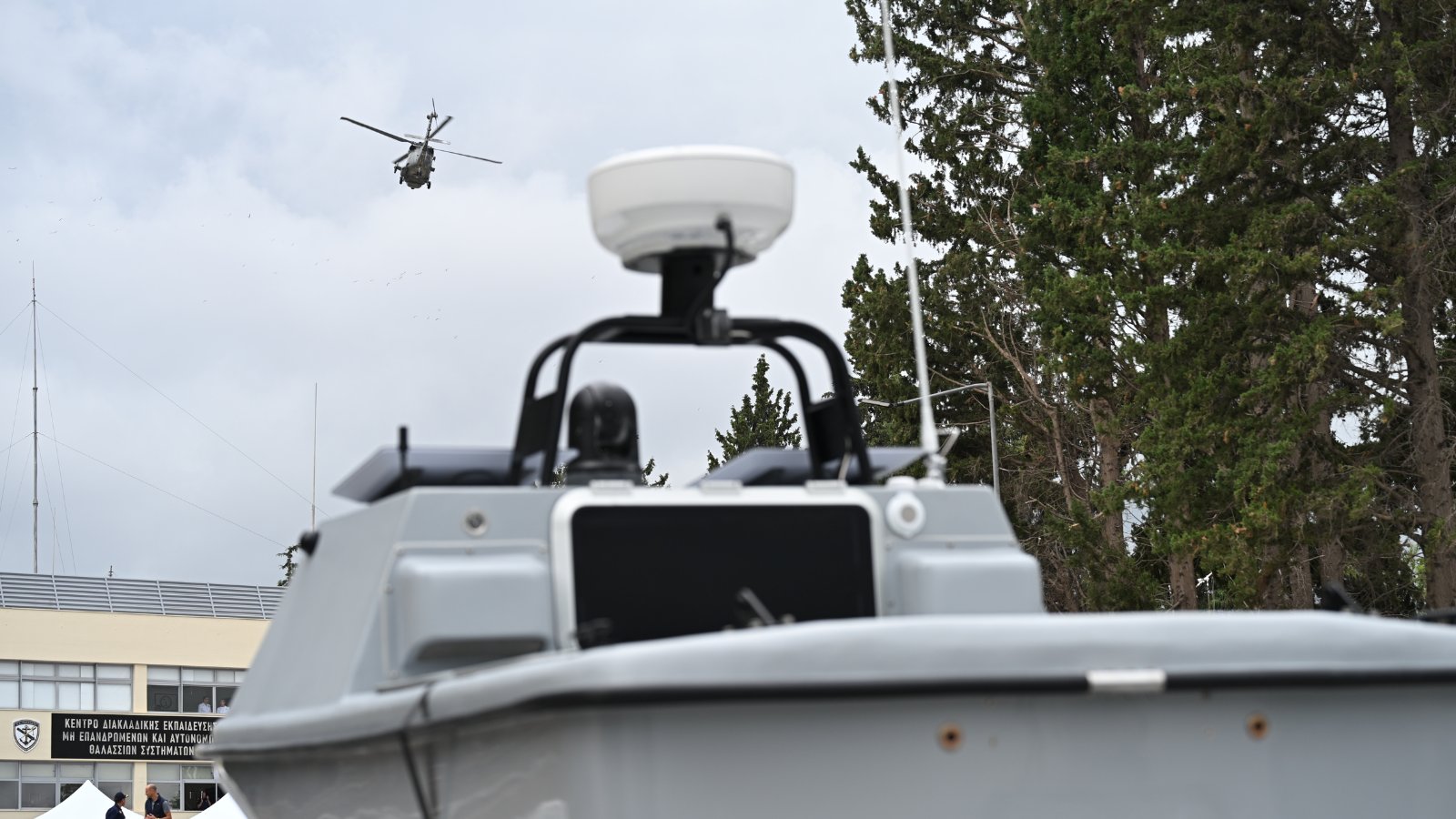
Ένα νέο εργαλείο για τη θαλάσσια επιτήρηση και τις επιχειρήσεις κρούσης παρουσίασε το Πολεμικό Ναυτικό, εντάσσοντας την εγχώρια ανάπτυξη μη επανδρωμένων συστημάτων στον σχεδιασμό ενίσχυσης του Στόλου.
Ο «Πυρπολητής», μη επανδρωμένο σκάφος επιφανείας που σχεδιάστηκε, αναπτύχθηκε και κατασκευάστηκε εξ ολοκλήρου από το Πολεμικό Ναυτικό, αποκαλύφθηκε την Τρίτη 13 Οκτωβρίου στο Ναυτικό Οχυρό Σκαραμαγκά. Η παρουσίαση έγινε κατά τα εγκαίνια του Κέντρου Διακλαδικής Εκπαίδευσης Μη Επανδρωμένων και Αυτόνομων Θαλάσσιων Συστημάτων, παρουσία του υπουργού Εθνικής Άμυνας Νίκου Δένδια.
Η σημασία του προγράμματος βρίσκεται τόσο στις αποστολές που μπορεί να αναλάβει όσο και στην ελληνική προέλευση της σχεδίασης και της κατασκευής του. Ο στόχος παραγωγής σε μεγάλους αριθμούς δίνει στο εγχείρημα προοπτική ευρύτερης αξιοποίησης από τον Στόλο, υπό την προϋπόθεση της επιτυχούς ολοκλήρωσης των δοκιμών.
Επιτήρηση και δυνατότητα προσβολής στόχων
Το σκάφος έχει μήκος πέντε μέτρων και μέγιστη ταχύτητα άνω των 40 κόμβων. Η αυτονομία του χαρακτηρίζεται υψηλή, χωρίς να έχουν ανακοινωθεί συγκεκριμένες τιμές επιχειρησιακής εμβέλειας ή διάρκειας αποστολής.
Διαθέτει ηλεκτροοπτικό σύστημα, ραντάρ επιφανείας, συστήματα επικοινωνιών και αισθητήρες για την πλοήγηση και την επιχειρησιακή χρησιμοποίησή του.
Σύμφωνα με τα στοιχεία της παρουσίασης, έχει σχεδιαστεί για τρεις βασικές κατηγορίες αποστολών: συλλογή πληροφοριών, επιτήρηση και αναγνώριση· επιχειρήσεις εναντίον στόχων επιφανείας· και επιθέσεις μονής κατεύθυνσης με μεταφορά εκρηκτικού φορτίου.
Στην τελευταία περίπτωση, το ίδιο το μη επανδρωμένο σκάφος αποτελεί το μέσο προσβολής. Προβλέπονται επίσης δυνατότητες περαιτέρω αναβάθμισης και διεύρυνσης των αποστολών του.
Οι ενσωματωμένες δυνατότητες αυτόνομης λειτουργίας βρίσκονται στο τελικό στάδιο δοκιμών. Η διάκριση έχει σημασία: η απουσία πληρώματος από το σκάφος και η αυτόνομη εκτέλεση λειτουργιών αποτελούν διαφορετικά χαρακτηριστικά, τα οποία πρέπει να αξιολογούνται χωριστά.
Η επιχειρησιακή κατεύθυνση που περιέγραψε ο Δένδιας
Ο υπουργός Εθνικής Άμυνας ανέφερε ότι ο «Πυρπολητής» μπορεί «να συλλέγει πληροφορίες, να επιτηρεί, να αναγνωρίζει, να λειτουργεί —όπως το όνομά του λέει— σαν σκάφος δυνατοτήτων επίθεσης εναντίον πλεόντων στόχων».
Παράλληλα, επισήμανε τη δυνατότητα μεταφοράς μέρους των αποστολών επιτήρησης και περιπολίας σε μη επανδρωμένα και αυτόνομα μέσα, με αντίστοιχη μείωση των ημερών παραμονής του προσωπικού στη θάλασσα.
Αυτή η κατεύθυνση αναδεικνύει τον συμπληρωματικό ρόλο των νέων συστημάτων στον Στόλο. Η αξιοποίησή τους μπορεί να διευρύνει τις επιλογές επιτήρησης και κρούσης και να επιτρέψει διαφορετική κατανομή των αποστολών μεταξύ επανδρωμένων και μη επανδρωμένων μέσων.
Από τα πυρπολικά στην ελληνική τεχνογνωσία
Η επιλογή του ονόματος συνδέει το πρόγραμμα με την παράδοση των πυρπολικών της Επανάστασης του 1821: τη χρήση μικρότερων σκαφών για την προσβολή ισχυρότερων εχθρικών μονάδων.
Στον σύγχρονο «Πυρπολητή», η ιστορική αναφορά συνοδεύεται από συστήματα αισθητήρων, επικοινωνιών και πλοήγησης, με το πλήρωμα να απουσιάζει από το μέσο που εκτελεί την αποστολή.
Το ουσιαστικό ζητούμενο είναι η διατήρηση και η εξέλιξη αυτής της τεχνογνωσίας. Η εγχώρια ανάπτυξη αποκτά επιχειρησιακή αξία όταν συνοδεύεται από αξιόπιστη παραγωγή, υποστήριξη και δυνατότητα αναβαθμίσεων σε βάθος χρόνου.
Εκπαίδευση σε ευρύ φάσμα θαλάσσιων συστημάτων
Το νέο Κέντρο Διακλαδικής Εκπαίδευσης προορίζεται για την εκπαίδευση και την εξοικείωση του προσωπικού με μη επανδρωμένα και αυτόνομα θαλάσσια μέσα.
Στην παρουσίαση περιλαμβάνονταν συστήματα επιφανείας για επιτήρηση, συλλογή πληροφοριών, υδρογραφικές έρευνες και αποστολές έρευνας και διάσωσης, καθώς και υποβρύχια μέσα για εντοπισμό και εξουδετέρωση ναρκών.
Μεταξύ αυτών ήταν τα FLEXUS, NIRIIS, BLUE BOAT, ΜΕΣΕ και ΚΑΝΑΡΗΣ «1» και «2», καθώς και τα υποβρύχια PLUTO PLUS και PLUTINO MIKI. Η ποικιλία των μέσων δείχνει ότι η εκπαίδευση καλύπτει περισσότερες αποστολές από την αποκλειστική χρήση σκαφών κρούσης.
Στα εγκαίνια της Διακλαδικής Σχολής Μη Επανδρωμένων, αλλά και των Αυτονόμων Συστημάτων Θάλασσας. Ένα περαιτέρω βήμα, που δημιουργεί τεράστιες δυνατότητες για το Πολεμικό Ναυτικό μας στο Αρχιπέλαγος, με τα Αυτόνομα Συστήματα τα οποία μπορούν να προσφέρουν απεριόριστες δυνατότητες στην επιτήρηση και αναγνώριση, στην προστασία των λιμένων, στον ναρκοπόλεμο και στην ασφάλεια των υποδομών.
Αυτό το νέο Πολεμικό Ναυτικό με τις σύγχρονες πλατφόρμες, θα μπορεί να προστατεύει όχι μόνο την κυριαρχία και τα κυριαρχικά δικαιώματα, αλλά και τα ενεργειακά και επικοινωνιακά δίκτυα στον βυθό, τα οποία είναι επίσης απαραίτητα για την ασφάλεια της Πατρίδας.
(από τον χαιρετισμό μου στην τελετή των εγκαινίων του Κέντρου Διακλαδικής Εκπαίδευσης Μη Επανδρωμένων και Αυτόνομων Θαλάσσιων Συστημάτων στο Κέντρο Εκπαίδευσης ΠΑΛΑΣΚΑΣ του ΠΝ)
#HellenicNavy
— Nikos Dendias (@NikosDendias) October 13, 2026
Το αίτημα για τα Corsair
Ξεχωριστή θέση είχε το Corsair της Saronic, μη επανδρωμένο και αυτόνομο σκάφος επιφανείας μήκους επτά μέτρων, με ταχύτητα άνω των 35 κόμβων.
Σύμφωνα με την ενημέρωση της παρουσίασης, διαθέτει δυνατότητα συνεργατικής αυτόνομης δράσης σε σμήνη και μπορεί να αναλαμβάνει αποστολές επιτήρησης, επιχειρήσεων κατά στόχων επιφανείας, επίθεσης μονής κατεύθυνσης και έρευνας και διάσωσης.
Το Πολεμικό Ναυτικό έχει πραγματοποιήσει δοκιμές και αξιολόγηση του συστήματος και έχει αποστείλει σχετικό Letter of Request για προμήθεια σκαφών μέσω του μηχανισμού Foreign Military Sales των ΗΠΑ. Η αποστολή του αιτήματος αποτελεί βήμα στη διαδικασία προμήθειας και δεν ισοδυναμεί με ολοκληρωμένη αγορά ή παράδοση.
Το κρίσιμο βήμα είναι η παραγωγή
Η παρουσίαση του «Πυρπολητή» αποτελεί αφετηρία για την αξιολόγηση ενός ελληνικού μη επανδρωμένου μέσου με πολλαπλές αποστολές. Η ολοκλήρωση των δοκιμών, η οργάνωση της παραγωγής και η ένταξή του στις διαδικασίες του Στόλου θα καθορίσουν το πραγματικό επιχειρησιακό του αποτύπωμα.
Μέχρι στιγμής δεν έχουν δημοσιοποιηθεί συγκεκριμένα στοιχεία για την εμβέλεια, το εκρηκτικό φορτίο, το κόστος ανά μονάδα ή το χρονοδιάγραμμα μαζικής παραγωγής. Τα διαθέσιμα δεδομένα τεκμηριώνουν τις κατευθύνσεις του προγράμματος· η συνολική αποτίμησή του θα απαιτήσει τα αποτελέσματα των δοκιμών και τις αποφάσεις για την παραγωγή.


Πόλεμος συμφερόντων για το LNG – Το τουρκικό σχέδιο και η ελληνική απάντηση
Στο Direct News, ο Ανδρέας Μουντζουρούλιας παρουσιάζει τις πληροφορίες του για τον GSI, αναλύει τα τουρκικά δημοσιεύματα για την Γκίλφοϊλ...


Arolsen Archives: Το αρχείο που αναζητά τα ίχνη εκατομμυρίων θυμάτων του ναζισμού
Στη γερμανική πόλη Μπαντ Άρολσεν φυλάσσεται μία από τις σημαντικότερες συλλογές τεκμηρίων για τα θύματα των ναζιστικών διώξεων. Περισσότερα από...


Πού βρίσκεται η Ελλάδα στον σχεδιασμό του IMEC;
Η επίκληση της ελληνικής κληρονομιάς, η κριτική για τις αμερικανικές τοποθετήσεις στα ελληνοτουρκικά και η ανάγκη μιας εθνικής στρατηγικής που...
Νέα τουρκική πρόκληση νότια του Καστελλόριζου! NAVTEX της Άγκυρας στην περιοχή που θα περάσει το γαλλικό ερευνητικό για το καλώδιο Ελλάδας–Κύπρου
Η Άγκυρα εξέδωσε NAVTEX για περιοχή νότια του Καστελλόριζου, όπου έχει προγραμματιστεί η πολυεθνική άσκηση «EUNOMIA», αμφισβητώντας τη δικαιοδοσία του...


EurAsia Review: Ποιοι προστατεύουν τα κυκλώματα λαθρεμπορίου στα σύνορα Ιράν, Πακιστάν και Αφγανιστάν – Ο σκοτεινός ρόλος παραγόντων ασφαλείας
Ένα εκτεταμένο σύστημα παράνομου εμπορίου, διαφθοράς και πολιτικής προστασίας περιγράφει σε ανάλυσή του το EurAsia Review. Από τα καύσιμα και...
-
 Αναλύσεις4 εβδομάδες πριν
Το τελεσίγραφο Καλίν την ώρα που η Τουρκία προετοιμάζεται για πόλεμο!
-
 Άμυνα3 μήνες πριν
Ρωσσικό ΜΜΕ: Ελληνικό «μπλόκο» στην απαίτηση για Patriot – Πώς γνωρίζει το Κίεβο απόρρητα στοιχεία για τους πυραύλους μας;
-

 ΑΝΑΡΤΗΣΕΙΣ ΜΕ ΣΗΜΑΣΙΑ3 μήνες πριν
Πακιστανός με καναδική υπηκοότητα ο υπαίτιος της πυρκαγιάς στον Έβρο! Πιθανόν να μετέφερε μετανάστες
-

 GEOPOLITICO1 μήνα πριν
Το διέρρευσε ο Παπαχελάς! Έφεραν τον Καλίν στο Μαξίμου – Τί συζήτησε με τον Μητσοτάκη;
-
 Αναλύσεις2 μήνες πριν
Καραγκιούλ: «Αν Ελλάδα, Κύπρος και Ισραήλ επιτεθούν στην Τουρκία, ο χάρτης του Αιγαίου θα αλλάξει»
-

 ΑΝΑΡΤΗΣΕΙΣ ΜΕ ΣΗΜΑΣΙΑ2 μήνες πριν
Ξέσπασμα της μητέρας της Μυρτούς για την υπόθεση Τζαβέντ Ασλάμ: «Δεν ξεχνώ ποτέ» – «Δήμαρχος των Πακιστανών ο Δούκας»
-

 GEOPOLITICO4 εβδομάδες πριν
Τί λέει Τούρκος δημοσιογράφος για Σάββα Καλεντερίδη; «Έκανε πολύ καλά τη δουλειά του για τη χώρα του – Δεν μπορούσε να τον στριμώξει η ΜİΤ»
-

 Αναλύσεις3 μήνες πριν
Εάν η Τουρκία απορρίψει τη συμφωνία αποχώρησης από την Κύπρο θα απομακρυνθεί δια της βίας