Αναλύσεις
Ένα προφητικό άρθρο: Turkey’s ambitions to emerge as a regional power; example or counter-example for potential aspiring competitors
Το παρακάτω άρθρο αν και δημοσιεύθηκε προ τριετίας, επαληθεύεται, καθώς γενικότερα εξέτασε τα στάδια εξέλιξης μίας χώρας σε περιφερειακή δύναμη, θέτοντας σχετικά κριτήρια και μελετώντας την περίπτωση της Τουρκίας ως παράδειγμα προς αποφυγή.
Turkey’s ambitions to emerge as a regional power; example or counter-example for potential aspiring competitors
ΠΡΩΤΗ ΔΗΜΟΣΙΕΥΣΗ: Academic journal of interdisciplinary studies (AJIS), 2017, Vol. 6, no. 3, pp. 25-32
Georgios C. Baltos1, Ioannis G. Vidakis2, Janis Balodis3
1. Ph.D of Business School, University of the Aegean, Chios, Greece.
2. Ph.D of Business School, University of the Aegean, Chios, Greece.
3. Analyst, Belaruassian Economic Research and Outlreach Center (BEROC), Minsk, Belarus.
Abstract: This paper aims to provide a functional assessment of a country’s dynamics at a regional power level, through the development of a tool which shall examine the working hypothesis of a given country’s “candidacy” to emerge as a regional power. The power equation applied in order to have such an evaluation has been formulated in a visually enriched and prototype format, given that particularly the geopolitics activate systems of interactions dynamically changing into many dimensions. The scope also includes the criteria verifying the achievement of the regional powers’ objectives as well as the review of future relevant prospects through a SWOT (strengths-weaknesses-opportunities-threats) analysis in a specific spatial and temporal context. Contemporary Turkey shall be taken as an example of this application and, therefore, while enumerating the assessment criteria, it will be briefly examined whether Turkey meets the conditions under discussion. This country has been selected on the grounds that its intentions have been overtly declared and its efforts are underway. The study consequently emphasises on the policy implications of the dilemmatic question if the on-going Turkish regime transformation may be or keep being a pilot for other states’ progress in the heavily turmoiled Middle Eastern area.
Keywords: power measurement, geopolitics, Turkey, regional power, power equation
Περίληψη: Αυτό το έγγραφο στοχεύει να παράσχει μία λειτουργική αξιολόγηση της δυναμικής μίας χώρας σε περιφερειακό επίπεδο ισχύος, μέσω της ανάπτυξης ενός εργαλείου που θα εξετάζει την υπόθεση εργασίας της «υποψηφιότητας» μίας συγκεκριμένης χώρας για να αναδειχθεί ως περιφερειακή δύναμη. Η εξίσωση ισχύος που εφαρμόστηκε για να έχει μία τέτοια αξιολόγηση έχει διαμορφωθεί σε οπτικά εμπλουτισμένη και πρωτότυπη μορφή, δεδομένου ότι ιδιαίτερα η γεωπολιτική ενεργοποιεί συστήματα αλληλεπιδράσεων που μεταβάλλονται δυναμικά σε πολλές διαστάσεις. Το πεδίο εφαρμογής περιλαμβάνει επίσης τα κριτήρια που επαληθεύουν την επίτευξη των στόχων των περιφερειακών δυνάμεων καθώς και την επισκόπηση των μελλοντικών σχετικών προοπτικών μέσω μίας ανάλυσης SWOT (πλεονεκτήματα-αδυναμίες-ευκαιρίες-απειλές) σ΄ ένα συγκεκριμένο χωρικό και χρονικό πλαίσιο. Η σύγχρονη Τουρκία λαμβάνεται ως παράδειγμα αυτής της αίτησης και, επομένως, ενώ απαριθμεί τα κριτήρια αξιολόγησης, θα εξεταστεί εν συντομία εάν η Τουρκία πληροί τις υπό συζήτηση προϋποθέσεις. Αυτή η χώρα επιλέχθηκε με το σκεπτικό ότι οι προθέσεις της έχουν δηλωθεί ρητά και οι προσπάθειές της βρίσκονται σε εξέλιξη. Η μελέτη δίνει συνεπώς έμφαση στις επιπτώσεις της πολιτικής του διλημματικού ζητήματος εάν ο συνεχιζόμενος μετασχηματισμός του τουρκικού καθεστώτος μπορεί να είναι ή να συνεχίζει να είναι πιλότος για την πρόοδο άλλων κρατών στην βαριά ταραγμένη περιοχή της Μέσης Ανατολής.
Λέξεις-κλειδιά: Μέτρηση Ισχύος, Γεωπολιτική, Τουρκία, Περιφερειακή Ισχύς, Εξίσωση Ισχύος
- Introduction:
In international politics, concentrations of power have been given, at times, several descriptions, “superpower” being prominent, namely a state capable of wielding power and influence at a global level, as introduced in an analysis by W.T.R. Fox and N. Spykman during the 1940’s – at the dawn of the then forthcoming post-war new order of things – but also, some decades earlier, by F. Ratzel who was prompted by the super power (Weltmacht) enjoyed by any certain country mainly through its maritime power (Waibl; Herdina, 1998).
Power is a significant attribute in the behaviours of countries that largely determines international relations. It should be underlined that power is defined in the context of certain circumstances and some of its aspects can be measured and, therefore, categorised on the basis of the degree to which a certain country is able to persuade, influence and/or even coerce other countries into complying with its wishes or otherwise suffer consequences and/or penalties should they refuse (Zagorin, 2006). An important “variation” of the meaning of superpower is “regional power”, namely a powerful state whose capabilities, however, in wielding power and influence are geographically limited. Studies on such a political phenomenon have produced certain theoretical listings of the characteristics identified in principle in regional powers over numerous historical instances. For example, according to the European Consortium for Political Research (University of Oxford, 2008), an inherent characteristic of a regional power is the hegemonic influence, in economic and military terms, exercised in a geographically defined region whose peoples recognise, accept or, at least, tolerate such an influence.
This study, however, aims to provide a more practical assessment of a country’s dynamics at regional power level, through the development of a tool which shall examine the working hypothesis of a given country’s “candidacy” to emerge as a regional power. The scope also includes the criteria verifying the achievement of its target and the review of its future prospects through a SWOT (strengths-weaknesses-opportunities-threats) analysis in a specific spatio-temporal context. Contemporary Turkey shall be taken as an example of such application and, therefore, while enumerating the assessment criteria, we shall be briefly examining whether Turkey meets the conditions under discussion. This country has been selected on the grounds that its intentions have been overtly declared and its efforts are underway.
According to a speech made by the then Minister of Foreign Affairs and incumbent Prime Minister, Ahmet Davutoğlu, who has the “trademark theory” of the so-called Strategic Depth (Statejik Derinlik): “… Turkish foreign policy is driven by three basic principles: a) a vision guiding its course, b) a no crisis-oriented attitude taking measures before crises emerge, and ultimately c) an integration course through systematic deployment on more than one axes…” (Karabat, 2010)). Also, according to one of his previous interviews: “… The region belongs to us. This is our home … We should take our destiny into our own hands, and for this we need full cooperation and regional integration. The foundation for it is in our history and geography … we shall combine our assets to get back the golden era in the region, which produced so many of the world’s important civilisations …” (Karabat, 2010).
- Methodology: a new form of power equation
The multi-level and complex issue of gaining or losing power is usually described by means of a polynomial. It is a useful method in so much as it condenses a series of thoughts under a brief and systematic formula which, on the one hand, can be easily communicated and, on the other, it demonstrates the variability of the solution. The causal variables are numerous, the criteria and the respective measurements varied. In the issue under consideration and in the Turkey case study, its prior Prime Minister himself, A. Davutoğlu (Davutoğlu, 2014), proposes such an equation in his book, namely:
P = {(Hi + G + Po + Cu) + (EC + TC + MC)}. * {SM + SP + PW}
whereas the acronyms are translated and explained as follows:
Hi: History, G: Geography, Po: Population, Cu: Culture, EC: Economic Capacity, TC: Technological Capacity, MC: Military Capacity, SM: Strategic Mentality, SP: Strategic Planning, PW: Political Will
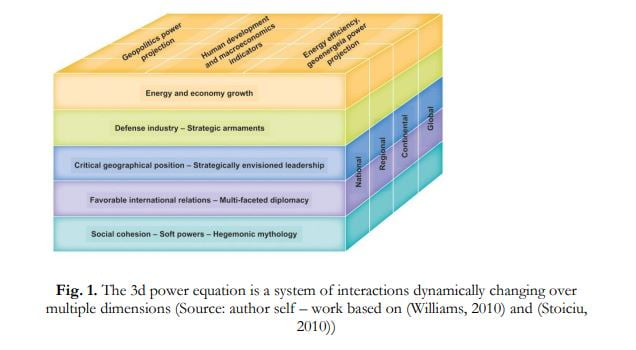
The power equation can be originally reformulated in a visually enriched format of analysis which is more appropriate to demonstrate that such an equation is a system of interactions dynamically changing into many dimensions. On the basis of the linear formulas, the polynomials are shown on one dimension, but the political realities derived from power projections are multi-dimensional and subject to a high degree of sensitivity, given that the power factors interact in a manner similar to the rotation of the “Rubik’s Cube” sides and edges:
Fig. 1. The 3d power equation is a system of interactions dynamically changing over multiple dimensions
(Source: author self – work based on (Williams, 2010) and (Stoiciu, 2010))
In a first theoretical description of the above presented figure (Fig. 2), the five components/power criteria at the front side of the cube are the means and/or the short-term objectives:
- Energy and economic growth
- Defence industry – strategic armaments
- Critical geographical position – strategically envisioned leadership
- Favourable international relations – multi-faceted diplomacy
- Social cohesion – soft powers – hegemonic mythology,
which interact with the three long-term objectives/strategic power indicators on the top cube’s surfaces:
Ι. Geopolitics power projection – ΙΙ. Human development and macro-economics indices – ΙΙΙ. Energy efficiency, geoenergy power projection
on the four geographical fields of operations as they appear on the third dimension at the side of the cube:
ι. National – ii. Regional – iii. Continental – iv. Global,
in order to configure, on the basis of the probable rotations of the cube sides around the 3d axes, hundreds of statistically possible power projection pathways, which are indicative of the complexity and the multiple factors involved in the achievement and sustenance of the major objective of acquiring and keeping power. It is worthy to highlight that a Rubik cube may 43.252.003.274.489.856 possible combinations (Stoiciu, 2010)!
- The criteria of a Regional Power’s emerge
On the basis of possible rotations of the faces around the alternative axes, dozens of statistically possible paths are shaped, indicative of the complex and multi-factorial requirements in achieving and maintaining specific objectives, we may proceed into the discussion of the major criteria that qualify countries as regional powers. This is possible because of the analogy between the country states, which motivate their societies towards the well-being of their people, with the majority of public and private sector organizations whose purpose is also to accomplice certain missions motivating their members, stakeholders and resources. In this context, leaders and managers are expected to wisely deal with the knowledge of where their organizations head to and how they get there; the wisdom itself is not related to any superficial skills but to the knowledge management, the configuration of processes and procedures supporting to the objectives’ achievement, the contingency planning, and most of all to the moderate mind-set required for effective crisis management. The risk analysis by definition involves forecasting, feedback, updating and worst case scenario development, given that any risk is no other than the probability of adversary to our objectives events to take place. The success of the leaders is directly interconnected to the extent they are capable of identifying, analysing and assessing risks, executing respective mitigation actions and follow up controls.
3.1 The 1st criterion: Energy sufficiency
It is taken for granted that superpowers consume exceptionally large energy resources and, consequently, shape their strategies and policies, in general, with a view to ensuring sustainably high availability in energy resources. Likewise, regional powers, although they manage smaller energy quantities, tend to play an active role in the energy issues of their broader region, in fact “dominating” the production or, alternatively, the supply of valuable energy resources.
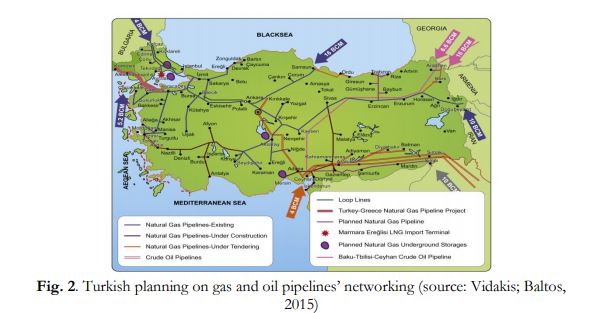
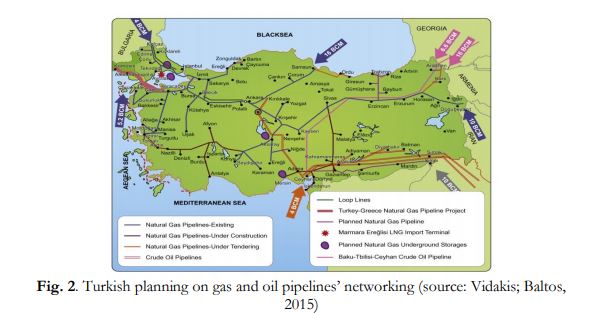
By applying this specific criterion in the case of Turkey, it can be easily assessed that this country systematically pursues its objective to become a leading actor in the so-called energy diplomacy. Many analysts, in the scope of adopting a respective geo-energy approach (Vidakis, 2016) have identified besides the traditional geopolitical considerations an abundance of geoenergy-related examples in Turkey’s respective policies (Energy security and Greece, 2009). Since the R.T. Erdogan’s Justice and Development Party (AKP) took over the government in 2002, Turkey has been energetically pursuing to become a highly crucial energy hub for the European and American imports as well as for Russian exports. It has focused its efforts on playing a politically and technically decisive role in the various projects for the construction and operation of an extended network of gas and oil pipelines (Asche, 2016).
In a similar way, Turkey is also an energy hub for the Middle East since it provides an overland route for the transport of large quantities of the Iranian natural gas, while at the same time it manages the significant water resources of the rivers Tiger and Euphrates, which are a major energy source of the Iraqi and Syrian economies. On the domestic front, during the first terms of the AKP government, major development programmes have been initiated and implemented as well as large-scale financial restructuring programmes in south-eastern Turkey (Karkazis, Vidakis, and Baltos, 2014).
Fig. 2. Turkish planning on gas and oil pipelines’ networking
(source: Vidakis; Baltos, 2015)
The first decade of AKP governments signalled an ambitious, robust and well-structured national and international energy policy. The latest updates though, referring to the last five years have indicated fatigue in the execution of the original planning, identified over projects cancellation and energy security issues prevailing. In the Oil Pipelines front, Kirkuk-Ceyhan Pipeline (Iraq-Turkey, 970 km-long twin pipeline system ferrying the quarter of Iraq’s crude exports): It has been damaged since the first Gulf War, leaving a capacity of just 500,000 b/d, while it is being repeatedly targeted by terrorists. In 2013, it faced 54 separate attacks, reducing the average throughput to the half. In early 2014 Northern Iraq completed a pipeline connecting its oil fields to the Kirkuk-Ceyhan pipeline. The pipeline is independent of Iraqi government oversight, has a capacity of over 400,000 b/d, while further pumping upgrades are expected to almost double the flow capacity. Additionally, the Baku-Tbilisi-Ceyhan Pipeline, originating in Azerbaijan, with a length of 1,760 km and capacity of around 1mn barrels per day, keeps transporting since 2006 the Caspian crude via Georgia to Turkey (BMI Research, 2017).
On the other front of the Gas Pipelines, the Blue Stream, since 2007 at a capacity of 16.0bcm, connects the Russian gas transit system to Samsun in Turkey, crossing the Black Sea and running on a joint venture between Gazprom and Eni. Strong demand in Turkey has driven to negotiations for the pipeline expansion. The Trans-Anatolian Pipeline (TANAP) will then take the Shah Deniz Phase II gas from Azerbaijan via Turkey onto Europe. The construction started in 2015 towards estimated works delivery in 2018, winning out over other proposals, like the Nabucco pipeline that was initially supported by the U.S. and the EU. On the other hand, the 900 km South Stream gas pipeline, designed to carry up gas from Russia, through the Black Sea, to Bulgaria, Greece, Hungary, Serbia, Slovenia, Croatia and Austria has been cancelled, since Gazprom was unable to realise the project in accordance with EU law.
Last but not least, since October 2016, Russia and Turkey have agreed on the construction of the Turkish Stream pipeline, with a delivery date around 2019. As of May 2017, the construction of the subsea pipeline has begun close to the Russian coast; there is though scepticism as to the size and effectiveness of this project in regard with the sufficiency of the existing infrastructure and/or the weak demand for gas in Europe.
The Turkish relevant strategy, although it is based completely on transportation rather than production of energy presents strengths and opportunities (Karkazis., Vidakis., Baltos, 2013) however, given the unstable political, internal and external environment, weaknesses and threats stem out of the limited operational freedom the cost disadvantages, the volatility of national and international energy policies, jeopardizing the sustainability of the Turkish energy prospective. It is indicative of the vulnerability afore-mentioned that following the collapse in oil prices in 2014, instead of reducing the fuel taxes that make up the bulk of the retail consumer basket, the government accused petroleum distributors of “profiteering”, imposing profit caps which operators complained made it impossible to operate at a profit (Wigen 2012). As a result, Turkey’s fifth-largest distributor, Total, sold up and left in 2015 (OxResearch Daily Brief Service, 2017).
3.2 The 2nd criterion: Economic growth
It is also self-evident that regional powers should be economically robust in proportion to the standards of their region. No country can emerge as a “regional leader” if it is drowning in uncontrollable debts and financial deficits. Almost all of the other criteria/prerequisites for the emergence of a regional power, in any part of the world, entail respective financial resources. It is also true that a flourishing economy, by itself, does not provide sufficient basis to this end. Such economy should be maintained on a continuous upward trend of growth and progress.
If we turn our attention to Turkey’s economic situation and relevant prospects during the first decade of AKP governance, we notice that the so called “neo-ottoman” governance had implemented radical changes, in terms of quality and quantity, insofar as the markets are concerned (Kinoğlu, 2014) pages 12-18. It is standard practice to refer to the so-called Anatolian Tigers, an elite of entrepreneurs affiliated to the governing party spreading not only in large cities but also into the depths of Anatolia, whose names increasingly occupy positions in the Forbes’ multi-millionaire lists, having lead Turkey to join the G-20 at frenzied growth rates with a relative stability, despite the undergoing crisis in the international economic environment. More and more “Made In “Turkey” products are exported to the international markets; not only the traditional textiles but also complex equipment and devices which require specialised labour in terms of production and industry. Furthermore, Turkey’s economic penetration in the other Muslim countries had been unprecedented, particularly with respect to the reconstruction of Iraq and Afghanistan.
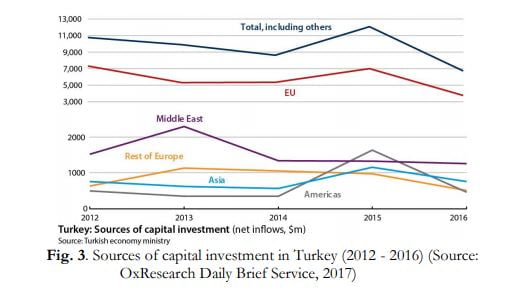
Turkey’s success in attracting outside investment peaked in 2007; since then it has been failing to match its peers and keep long-term and high levels of foreign direct investment (FDI). On the opposite, over the last years numerable high-profile investors have started leaving operations. In the context of growing worries connected with threats of companies’ and assets’ seizures under the government’s anti-Western rhetoric as well as the excuse that owners and executives have been alleged to be related with the failed coup of July 2016, the FDI rises but slowly. Given the regional insecurity, the immense concentration of power under the president’s control, combined with the “draconian” reaction to the coup attempt, it seems the past investment levels are likely out of reach over the next months. It depends on the duration of the political instability whether international investors stay or cut their (Oxford Analytica Daily Brief Service, 2017).
The financial analysts expect that the failed coup, the aggressive government’s crackdown on the opposition, along with the recent security risks from terrorist attacks have blurred the country’s global economic outlook towards negative medium-term economic results. The real GDP growth was in 2015 upwardly revised to 5.9%, due to methodological adjustments on the national accounts, but then it was revised down from 3% to 2.2% in 2016 and an estimated 2.6% in 2017. It is assessed that a gradual stabilisation of internal political situation over 2018-21 will drive to real GDP growth of average 3.7% per year. Nowadays, the possibility of a serious disruption to capital inflows is considered likely and taken into account by the subject matter experts (EIU ViewsWire, 2017).
Fig. 3. Sources of capital investment in Turkey (2012 – 2016)
(Source: OxResearch Daily Brief Service, 2017)
3.3 The 3rd criterion: Strategic armaments and Defence Industry
Military power is the main lever for regional recognition. This is not directly related to aggressive or imperialistic behaviours. The mere existence and availability of military capacities are taken additionally into account in favour of a country towards peacekeeping and stability. Should circumstances arise, in the course of time, that demand high efficiency and effectiveness, it stands to reason that such a country may achieve further positive results. Nevertheless, in the case of a regional power, military equipment and its subsequent management should have specific “quality” features indicative of a special dynamic influence in the surrounding geopolitical and geostrategic scene. Such armaments should have enhanced “range” and surpass the standard conventional numbers existing in neighbouring countries.
If, for instance, Turkey seeks – and it is indubitably working towards this goal – to emerge as a regional power with increased control in the Middle East and Eastern Mediterranean affairs, numerous armed forces, aircrafts and frigates are no longer sufficient, as the case was in the past decades. On the contrary, current requirements urge for force multipliers, state-owned satellites, infrastructures for exploiting nuclear power, smart weapons such as unmanned and surveillance aircrafts, stealth technologies, aerial refuelling capabilities, cyber warfare, air-carriers, partnerships with pioneering manufacturers and, primarily, a domestic defence industry which ensures a high degree of independence in the political and military decision-making process. The above brief reference to strategic force multipliers is, at the same time, a listing of those that Turkey is systematically and gradually trying to have completely implemented by the dawn of the next decade. It is the precise answer to the rhetorical question asked in the beginning of this paragraph with respect to the steps that Turkey should take in its armaments sector, if it aspires to become in the long run a regional leader in the Eastern Mediterranean basin (Pamuk., Gurses, 2016).
In line with the above, Turkey has reached the world’s 14th top military spending position in 2013 from the 16th place in 2012, according to April 2014 data published by SIPRI. Turkey’s military expenditure was of $19.1 billion for 2013 (2.3% of GDP. The increase in the long run, between 2004 and 2013, was of 13% in real terms. It should also be taken into consideration that Turkey has been met with new security problems, particularly those related with the civil war in Syria (BBC Monitoring European, 2014).
Apart from the fact that the Turkish army is the NATO’s second biggest, it also launches plenty of indigenous weapons programs, including missiles, battle tanks and vehicles, a fighter jet, corvettes and frigates, helicopters, satellites, and drones. However, the 15 of July 2016 attempted coup reconsidered the military planning and programming in terms of human capital, given that more than 8,000 officers, including almost half of the generals and the admirals in the Turkish military’s ranks, were discharged, weakening consequently the command structure from the top to the bottom. The government transferred military industries under civilian authority.
In an environment of several asymmetrical wars, terrorist attacks and long-lasting militarily engagement in Syria crisis, numerable military training units were shut down. Just after the coup attempt, the government issued an executive decree almost evacuating the traditional military academies. They are being replaced by new academies operated by universities while the Defense Ministry establishes a strict oversight of their programs and activities. In a highly symbolic way, female and non-commissioned officers have been allowed to wear Islamic headscarves in the armed forces, while thousands of senior officers have been detained on the accusation that they are keeping ties with Fethullah Gülen, who, despite that he had been a spiritual and respectful mentor for R.T. Erdogan and his political movement far away in the past, was according to the government the master mind behind the preparation and execution of the 2016 coup attempt. On the other hand, the latter Turkish Imam himself, denies any involvement and declares himself as a victim of political conspiracy (Grove, 2017).
The severity of the internal security problems created by the failed coup attempt in 2016 may have tremendous impact not only on the current Turkey’s political direction but also on the fighting morale and capabilities. It has already caused a major trouble for NATO and western allies due to the purging of thousands of Turkish officers, giving the impression that Turkey is sliding away from democracy and rapidly damaging relations with allies such as Germany (CBRN Assessment, 2017).
At the background of the actions that compile the socio-political surface of the current state of emergency, it is already proven that Turkey’s military has been of the most politicized institutions. It has represented the secular elite for decades, it repeatedly overthrew elected governments and fiercely opposed the religious political parties like R.T. Erdogan’s AKP. However, the July 2016 military putschists not only demonstrated operational ineffectiveness towards their irregular way of pursuing political power but also failed in projecting legitimacy and social recognition. The fact that AKP in the aftermath of the failed coup constructed and disseminated an authoritative as well as heroic “narrative of the July 15 resistance”, enabled the government to perform deep institutional changes that will configure a new order in the cultural, economic, and socio-political domains of Turkish state (Altinordu, 2017).
3.4 The 4th criterion: Geopolitically critical position
Quite a few countries may carry the attributes of a regional power, remaining though at the margin of geopolitics if not at the margin of geography itself. Since politics are relative and subject to changes, no one is in a position to know where the history’s spotlights will focus on over the forthcoming decades. Let us consider, for instance, the time when the exploitation and distribution of wealth on the earth’s poles will commence; the time when, as a consequence, the countries bordering the Arctic and the Antarctica will play a leading part, no matter if they are eager to get involved, in vigorous redeployments with respect to taking over the title of superpowers and regional powers.
For the time being, however, the “known” world of western history, the centuries-old Europe and, further afield, the “blazing” Middle East are, to their peoples’ blessing or discontent, some of the “iron threshing floors” at the edges of which forces and underlying leadership aspirations are thronged and crushed. This is where “the soil is drenched in blood and bears witness to biblical conflicts”, both just and unjust, while people’s collective memory has registered dreadful disasters and liberating visions in the dynamic wake of history. Given the relevant opportunities, those who possess maritime passages, points of access to energy treasures and traditional crossroads of nations, are virtually “driven” to contemplate and envision a place in the pantheon of the regional, to say the least, and international political powers (Bekdil, 2017).
There is no doubt that, in terms of geography and geopolitics, Turkey is uniquely placed, as described above with a dash of surrealism, which is justifiable to a certain extent given the political importance and the history of the strip of land connecting Europe with Asia and Africa. The same geo-cultural area is the cradle of great nations and civilisations. The United States, as the most significant super power on the planet, often appear to recognise Turkey as a key-country for the control of the political and military situation on the Middle East scene, but also as a bulwark to a potential expansion of Russian control over the Eastern Mediterranean for many decades and irrespective of the socio-political changes in Russia (Reuters stuff, 2016).
3.5 The 5th criterion: Leaders with mastery of powers
Modern Turkey has been governed for almost two decades by leaders alternating roles but always under the political Islam orientation: A. Gül, R. T. Erdogan, B. Arinç, A. Davutoğlu, etc. have certain particularly noteworthy leadership characteristics. For the purpose of this analysis, it would suffice to mention that the former prime minister has worked his way up to the office of president while the minister of foreign affairs has become prime minister. In addition, the former minister of foreign affairs was previously the main advisor to the prime minister in creating a modern international policy, the president was minister of foreign affairs, the prime minister with the deputy prime minister founded the governing party (AKP, Justice and Development Party), while all of them were not only displaying common party origins but were also sharing a leader’s profile which is obviously nurtured by the vision of a powerful Turkey and, also, a vision of political ethics driven by political Islam and distant to the old times kemalists’ militaristic and elitist practices.
Ten years ago, who could have even remotely contemplated that, in Turkey, about three hundred senior military officers would have been arrested in the fight against the “Ergenekon” organisation and the “Sledgehammer” (Balyoz)” operation without destabilising the political and social balance, and the party’s balance… And yet it happened, which means that the so-called Islamic leading group, “the neo-Ottoman leadership” mentioned earlier, has deep and broad popular support but, at the same time, it has closed ranks with middle-class administrative mechanisms which bring intentions to fruition and fight for the making and execution of decisions in a particularly adverse environment politically undermined by competing kemalist coalitions. Such a feat cannot be achieved without inspired and determined leaders that assiduously mastermind the necessary plans in order to implement them step by step (Esayan, 2013).
3.6 The 6th criterion: Favourable international relations
Although regional powers have been described above as small-scale replicas of the superpowers, this comparison, albeit helpful to understand attitudes and behaviours, is not entirely valid. One of the obvious differences between regional powers and superpowers is that the former are dependent on the latter far more than the latter depend on the former. From another perspective, regional powers should not, at least, raise problems to the superpowers in the execution of their plans. Ideally for both, regional powers should develop policies and strategies in line with the objectives of the superpowers in every region and worldwide (Pipes, 2017).
In Turkey’s case, the path to its establishment as a regional power is conditional upon the consent of the United States and Russia. It further depends on Turkey’s strategic choices which will convince the superpowers that their “ally” will protect their interests accordingly. The hypothesis that Turkey meets this specific criterion calls for careful and thorough consideration because both the interests and policies of the “Great Powers” are often unclear, relative, changeable and competing, while there may be unforeseen surprises which history holds in store for all nations on earth, irrespective of their size and their rationally estimated capacities.
It is, however, certain that the international environment, and especially during the 2000s, was in general lines favourable for Turkey. One of the main requirements of the then Obama’s first administration was that Turkey would actively strive to project a more secular, moderate and pro-western profile of political Islam in the Middle East. It was an ambitious experiment in order to disengage the West from the ghost of Islamic fundamentalism by winning “the hearts and thoughts” of the Muslims in the wider region. On the other front, Putin’s Russia chose Turkey as its strategic partner in geo-energy matters and thus succeeded, even indirectly, in realising its centuries-old aspiration to have a gate open to the Eastern Mediterranean.
Taken into consideration that the currently most wanted political enemy of the government in Turkey, Fetulah Gülen, has found resort on U.S. territory, the AKP government keeps the U.S.-Turkey relationship in tension by continuously challenging the White House for the F. Gülen’s immediate extradition. The two traditional NATO allies have also been diverged widely in regard with the role and support of the Syrian Kurds, whom Ankara considers terrorists, while Washington appreciates in several ways their ground operations’ effectiveness against the Islamic State. R.T. Erdogan’s even claimed that a lot of U.S. official statements criticising the Turkish government’s stance in the aftermath of the coup were indicators (Daily Herald, 2016) that western politicians, academics and journalists were somehow siding with the coup plotters (Daily News – Leading News Source for Turkey and the Region, 2017).
In the same page, Turkish Defence Minister Fikri Isik highlighted that NATO should sit down and think where it went wrong in response to the coup attempt (Daily News – Leading News Source for Turkey and the Region, 2017). Justice Minister Bekir Bozdağ stated that U.S. would be sacrificing its alliance with Ankara to “a terrorist” [Gülen] if it were to refuse to extradite him (Daily Herald, 2016). Foreign Minister Mevlüt Çavuşoğlu even threatened that Turkey might look outside NATO for defence cooperation (Zorthian, 2016). Turkey kept normalizing its multi-level ties with Russia, implying against NATO that it may change direction. R.T. Erdogan apologized to President Vladimir Putin for shooting down a Russian military aircraft in November 2015 (Yinanç, 2017). Putin afterwards recalled his economic sanctions and travel bans against Turkey, and recovered all government-to-government relations (Jamieson, 2016)). The developments please not only V. Putin but also Tehran, his partner in the Syrian civil war, and puts Ankara on an ironic trade off by siding the Russian-Iranian Assad’s coalition with whom Turkey suffered an almost five year-old hostile relationship and conflict.
A strategic axis of responses to the failed coup was the further weakening of Turkey’s links with the West (Bekdil, 2017). The latter calls on Ankara to respect the “rule of law” and democracy, but instead, R.T. Erdogan declares intentions to reinstate the death penalty, making rhetorical questions like “Why should I keep them [the mutineers] and feed them in prisons for years to come?” (Pamuk., Gurses, 2016)) On the other side, Federica Mogherini, the European Union’s foreign policy chief, answered that the re-introduction of the death penalty, would cancel any Turkey’s option to ever enter EU (Daily News – Leading News Source for Turkey and the Region, 2017). German foreign minister Frank-Walter Steinmaier characteristically added that because of the mass arrests and sweeping purges the two countries are like “emissaries from two different planets.” (Reuters, 2016).
3.7 The 7th criterion: Social Cohesion
A first approach to regional powers as geopolitical phenomena places emphasis on the international diplomacy scene. However, there is also the national dimension to be taken into account, namely all that happens on the domestic front, within each regional power’s society. In such a context, the critical factor for gaining state control, which will also reflect in the country’s international relations, is the internal political cohesion, expressed in national, social and other axes of the institutional life. If a country seeks to play a catalytic role in its neighbours’ problems, it must ensure that its internal problems have been solved and the actual or potential instability hotbeds affecting its citizens’ daily lives have been eliminated. How could it convince of its capability of dealing not only with its own external rivals but also with those of other countries, if it cannot deal effectively with its internal enemies?
Insofar as Turkey is concerned, fulfilling the above criterion appears to be particularly difficult. More than 15% of its population consists of the Kurdish ethnic minority with which the official state has been in continuous and multi-form conflict for decades (Central Intelligence Agency, 2017). The Kurds’ resistance to the restriction of their ethnic and political rights is a time-bomb threatening Turkey’s political edifice. In any case, the mere existence of the Kurdish matter constitutes not only a critical destabilising factor but, potentially, a means of pressure to be used by the superpowers in order to control future developments in the region.
At a state level, the rift between the incumbent government and the opposition is not limited to the narrow context of power struggle between political parties. Turkey is constantly undergoing a political revolution with leading actors the institutions themselves, the political parties, the armed forces, the justice system, the universities, the press, financial and religious players, etc. It is the majority of this specific society’s gravity centres which are themselves in conflict with each other given that they have taken sides either with the neo-ottomanism or kemalism proponents.
These two constitutional ideologies reflect, as a whole, the different approach to the national structure and administration of the state, while they are painstakingly trying to close ranks with individual decision-making centres across the entire spectrum of Turkish society. Thus, it can be assessed that, traditionally from the establishment of the Turkish Rebublic till the dawn of this century, the armed forces, higher education, the justice system and business entrepreneurs have taken the Kemalist line but, currently, the neo-Ottomans have sided not only with the government but also with the security forces, the religious centres, the masses of ordinary citizens and important business centres of the country (Kinoğlu, 2014). However, the latest constitutional revision on the roles of the army and justice is another ongoing situation representative of the conflict among Turkish institutions, and it has taken such extent that it is close to giving rise to potential violent reversals with unforeseeable consequences for the political and social cohesion of the country.
In the context of the newly established Turkish presidential system, the prime minister “disappears” while the president holds vast power over the other powers, namely the parliament, the judiciary, as well as the budget and the military (Ege, 2016). The political emphasis on imbuing the presidency with complete socio-political control was for decades a top priority for the political Islam agenda in Turkey, as it has been also promoted by N. Erbakan and other leaders of the Islamic parties since the 70’s (Al-Arian, 2017). However, the current surrounding social environment is full of severe conflicts and turmoil. In the name of the imperative for a strong presidency, the referendum procedures have been criticised as non-transparent, near-civil war has started with the Kurds, while a crisis with Europe is being continually provoked. R.T. Erdogan cracked down on Gülen’s followers, leading to approximately 47,000 arrests, 113,000 detainments, 135,000 firings or suspensions from jobs, etc. (Başaran, 2017). The cautiousness and admirable efficiency with which R.T Erdogan became prime minister in 2003 and governed for eight years, achieving remarkable economic growth, containing the military leadership’s abusive overpowers and pursuing a policy of “zero problems with neighbours”, since 2011, has been vaporised (Pipes, 2017).
- Comparative and SWOT Analysis – Policy implications
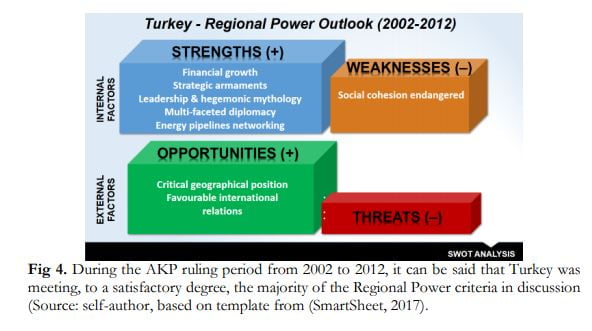
In a SWOT analysis a basic distinction is made, on the one hand, between strengths and weaknesses which are identified in the internal environment of the entity assessed and, on the other hand, between the opportunities and threats which reflect the entity’s external environment (Pahl and Richter 2009) . More specifically, with respect to Turkey’s internal strengths on the path to emerge as a regional power, during the AKP ruling period from 2002 to 2012, it can be said that Turkey was meeting, to a satisfactory degree, the criteria mentioned in the above analysis as well as at the figure below (Fig. 4):
Fig 4. During the AKP ruling period from 2002 to 2012, it can be said that Turkey was meeting, to a satisfactory degree, the majority of the Regional Power criteria in discussion
(Source: self-author, based on template from (SmartSheet, 2017).
During the 2000s, in a rather paradoxical manner, Turkey earned the respect or at least the acceptance of Americans, Russians, Iranians and Israelis, while at the same time Europe was looking forward to having a special cooperation scheme with Turkey towards its accession to the E.U. Additionally many Balkan nations declared themselves to be Turkey’s historical allies, while several Caucasian nations pursued cooperation or common politico-economic ground with Turkey. The fact is that Turkey was steadily and consistently intervening practically on all neighbouring fronts that could conceivably be open in its wider region.
According to A. Davutoğlu’s various official statements, Turkey’s foreign policy over the first AKP decade in power dealt with regional problems, aiming to eradicate problems with its neighbours through a balancing, “rhythmic” diplomacy (“zero problems” principle) and worked towards the objective that Turkey should be seen, naturally and freely, as the ideal mediator, the prime protector and guarantor of normality in the region.
Passing, however, from the 2002-2012 to the 2012-2017 period, which was marked by the absence of A. Davutoğlu’s sophistication and Abdullah Gül’s moderation, Turkish internal and external political scene has changed not only in the nature and characteristics of all its criteria and components described before, but also in terms of strengths, weaknesses, threats and opportunities, as the figure below (Fig. 6 successing Fig. 5) graphically illustrates, highlighting Turkey’s main difficulty in bringing its efforts to fruition. Furthermore, both its “multi-faceted and outward-looking diplomacy” as well as its excessive “hegemonic mythology” turned from strengths to weaknesses, where meddling with the Arab Spring expansion and the Syrian crisis resolution have led to severe military engagements, wastage and squander of resources, while mythology encourages superiority complexes and obsessions which, in turn, deprive policies of the realism and the risk management required for successful outcomes:
Fig. 5. During the AKP ruling period from 2012 to 2017, it can be verified that the overdose of its multi-faceted diplomacy and “hegemonic mythology” tend to turn from strengths to weaknesses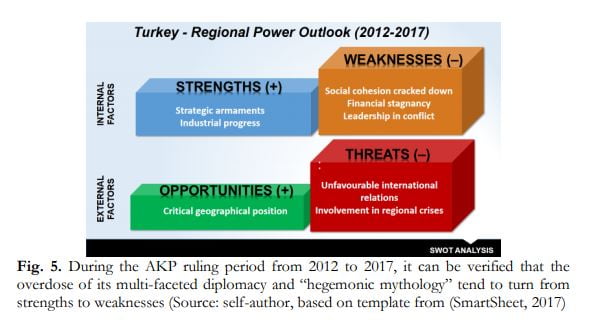
(Source: self-author, based on template from (SmartSheet, 2017)
- Epilogue
If the afore-mentioned Regional Power criteria were to be briefly assessed and distinguished between “mandatory” and “supportive”, criteria numbered: 1 (Energy sufficiency), 2 (Economic growth), 3 (Strategic armaments) and 6 (Favourable international relations) would be rated as mandatory (sine qua non) in the process and, more so, in maintaining a cutting-edge and long-term regional leadership, while criteria numbered 4 (Geopolitically critical position), 5 (Leadership) and 7 (Social Cohesion) would probably be rated as merely supportive for every regional power.
The above analysis certainly leads to conclusions with respect to the success, or the possibilities of success, of Turkey’s foreign policy in fulfilling its objective not only to emerge but also to be established as a regional power. Such conclusions can be quantitatively justified in a further research on the basis of percentage/numerical estimates for the assessed performances per criterion. It is also a pre-requisite that the review of a country’s candidacy for becoming a regional power is related to the competition that may be prevalent in a particular geopolitical region among several countries claiming the same or antagonistic leading role. This, surely, depends on the geopolitical circumstances prevailing each time, “how many leaders a kingdom can sustain”; in other words, how many regional powers and what distribution of power among them may lead the particular geopolitical region to balance and stability. Focusing on the Eastern Mediterranean and Middle East regions, it is noted that Turkey is not the only suitor of leadership. Traditionally, Israel has been a leading figure in the region and it could certainly be the object of a similar study that would review the verification of the criteria under consideration insofar as Israel is concerned.
Another challenging suitor of the particular “leadership” is Iran which may also score a satisfactory number of points based on the scale of the criteria under consideration, particularly if ever acquire nuclear power for military purposes. Such list could be further extended if, for instance, Egypt’s influence in the Middle East and the Greater Maghreb is taken into consideration. Based on this premise, it would be interesting to know the answer to the question if and to what extent mainly Israel and Iran, each country for its own reasons, will try and manage to harness Turkish aspirations.
Last but not least, we have clearly identified and assessed a rift between the first ten years and the follow up five latest of AKP ruling. Actually, it is a progressive transition carrying though extremely dynamic and revisionary characteristics. The study’s title emphasise on the dilemmatic question, is the Turkish regime transformation a pilot for other states in this heavily turmoil area? The answer if Turkey is an example or a counterexample with a negative connotation, refuting the powerful expectations, is definitely related with the way the transformation itself is being developed; there are strong evidences that, despite the initial reasonable potential for democracy, progress and prosperity, the latest evolution worryingly indicates that regional peace and stability are challenged.
References:
Al-Arian, Sami, (2017),Turkey, Erdoğan, and the Wisdom of the Presidential System. [Online] Available: http://thenewturkey.org/turkey-erdogan-and-the-wisdom-of-the-presidential-system/(September 5, 2017)
Altinordu, A. (2017). A Midsummer Night’s Coup: Performance and Power in Turkey’s July 15 Coup Attempt. Qualitative Sociology, 40, 139-164.
Asche, Christop, (2016), It’s Time For ‘Erdogan’s Coup’: Threatened Journalist Expects Widespread Backlash In Turkey. [Online] Available: http://www.huffingtonpost.com/entry/can-dundar-journalist-turkey-coup_us_578e4dcee4b0a0ae97c38844 (September 5, 2017)
Başaran, Ezgi, (2017) Thinking Gülen is a peaceful scholar is a huge mischaracterization. Daily News – Leading News Source for Turkey and the Region. Available online at http://www.hurriyetdailynews.com/thinking-Gülen-is-a-peaceful-scholar-is-a-huge-mischaracterization.aspx?pageID=449&nID=102173&NewsCatID=548 (September 5, 2017)
BBC Monitoring European, (2014), Turkey becomes world’s top 15 military spender. BBC Monitoring European. [Online] Available: https://www.dailysabah.com/turkey/2014/04/15/turkey-becomes-a-top-15-military-spender (September 5, 2017)
Bekdil, B. (2017). Turkey’s Slide into Authoritarianism. Middle East Quarterly, 24, 9-1.
Bilgin, P. (2007). Only strong states can survive in Turkey’s geography’: the uses of ‘geopolitical truths’ in Turkey. Political geography, 26, 740-756. (September 5, 2017)
BMI Research, (2017), Turkey Oil & Gas Report, [Online] Available: http://store.bmiresearch.com/turkey-oil-gas-report.html (September 5, 2017)
Central Intelligence Agency, (2017), Turkey. [Online] Available: https://www.cia.gov/library/publications/the-world-factbook/geos/tu.html (September 5, 2017)
Daily Herald, (2016), Turkey: US shouldn’t ‘sacrifice’ alliance over Muslim cleric, [Online] Available: http://www.dailyherald.com/article/20160809/news/308099977/ (September 5, 2017)
Davutoğlu, Ahmet, (2014), Stratejik Derinlik Türkiye’nin Uluslararası Konumu (Ciltli). [Online] Available: http://www.kitapyurdu.com/kitap/stratejik-derinlik-amp-turkiyenin-uluslararasi-konumu-ciltli/33240.html (September 5, 2017)
Ege, Seckin. 2016. “Turkish president poised to seize more power.” Jane’s Intelligence Review 28, 1-8.
EIU ViewsWire Turkey: Country outlook. [Online] Available: http://store.eiu.com/product.aspx?pid=50000205&gid=1450000145&pubid=1690000969 (September 5, 2017)
Esayan, M. (2013). Ergenekon: An illegitimate form of government. Insight Turkey, 15, 29-40.
Reuters, (2016). German minister sees `no basis’ for talks with Turkey after failed coup. Reuters. [Online] Available http://www.reuters.com/article/us-turkey-security-germany-idUSKCN10F23D (September 5, 2017)
Jamieson, Alastair, (2016), Turkey’s Erdogan Meets Russia’s Putin for ‘New Page’ in Restored Relations, [Online] Available: http://www.nbcnews.com/storyline/turkey-military-coup/turkey-s-erdogan-meets-russia-s-putin-new-page-restored-n626101(September 5, 2017)
Karabat, Ayşe, (2010), Turkey Creates Balance in the Middle East. [Online] Available at: https://en.qantara.de/content/interview-with-turkeys-foreign-minister-ahmet-davutoglu-turkey-creates-balance-in-the-middle (September 5, 2017)
Institute of Internal Auditors, (2017), Risk Management. [Online] Available at: https://na.theiia.org/standards-guidance/mandatory-guidance/Pages/Standards-Glossary.aspx (September 5, 2017)
Karkazis, J, Vidakis, I. G., Baltos, G. C., (2013). The Energy Wealth of Syria. Foreign Affairs, The Hellenic Edition, 20, 104-118.
Kinoğlu, S.D. (2014), Neo-Ottoman Perspectives: Turkish Identity and Culinary Culture in a Sociopolitical Context: Oregon State University.
Oxford Analytica Daily Brief, (2017), MIDDLE EAST: Nuclear energy will diversify Middle Eastern ties. [Online] Available at: https://dailybrief.oxan.com/Analysis/DB221905/Nuclear-energy-will-diversify-Middle-Eastern-ties (September 5, 2017)
Parisis, I. (2011). Power Factors in the International System. Infognomon Publications, 2,44-67.
OxResearch Daily Brief Service, (2017), Turkey: FDI is unlikely to return to mid-2000s peak. [Online] Available: https://dailybrief.oxan.com/Analysis/DB221494/FDI-is-unlikely-to-return-to-Turkeys-mid-2000s-peak.
Pamuk, Humeyra., Gurses, Ercan, (2016), Turkey widens post-coup purge, demands U.S. hand over cleric. Reuters. [Online] Available: https://uk.reuters.com/article/turkey-security-int-idUKKCN0ZX07Z(September 5, 2017)
Pipes, D.(2017). Turkey’s man of mystery. Weekend Australian. 24, 10 – 15.
Roberts, P. (2005). The End of Oil: On the Edge of a Perilous New World. Houghton: Houghton Mifflin.
SmartSheet, (2017), 14 Free SWOT Analysis Templates, [Online] Available: https://www.smartsheet.com/14-free-swot-analysis-templates (September 5, 2017)
Stoiciu, Mihai, (2010), Rubik’s Cube Turns 30. [Online] Available: https://math.williams.edu/rubiks-cube-turns-30/Turkey to be ‘elephant in the room’ at NATO summit. CBRN Assessment. [Online] Available http://www.janes.com/article/70523/turkey-to-be-elephant-in-the-room-at-nato-summit (September 5, 2017)
Grove, Thomas, (2017), Turkey’s First Post-Coup Recruits Mark Change in Military; President Erdogan rebuilding armed forces after last year’s failed putsch.Wall Street Journal. [Online] Available at: https://www.wsj.com/articles/turkeys-first-post-coup-recruits-mark-change-in-military-1487848184 (September 5, 2017)
Vidakis, I. (2016).Energy network security in the Eastern Mediterranean: Turkey’s role. (Doctoral dissertation, University of the Aegean).
Vidakis, I., and Baltos, G. (2015). Security Aspects of ‘Geoenergeia’ and the Significance of Energy Resources Management in International Politics. Geopolitics of Energy, 37, 2-16.
Waibl, E., Herdina, P. (1998). German Dictionary of Philosophical Terms/ Woertbuch Philosophischer Fachbegriffe Englisch: English – German. Routledge: Abingdon-on-Thames.
Western allies urge Turkey to maintain rule of law after failed coup. Daily News – Leading News Source for Turkey and the Region. Available online at http://www.hurriyetdailynews.com/eu-pushes-turkey-on-rule-of-law-after-coup-crackdown-.aspx?pageID=238&nID=101736&NewsCatID=351 (September 5, 2017)
Wigen, E. (2012). Pipe Dreams or Dream Pipe? Turkey’s Hopes of Becoming an Energy Hub. The Middle East Journal, 66, 598-612.
Williams, (2010), Rubik’s Cube Turns 30.. [Online] Available: https://math.williams.edu/rubiks-cube-turns-30/ (September 5, 2017)
Yinanç, Barçın, (2017), NATO needs to look in mirror on coup attempt, says Turkish Defense minister. Daily News – Leading News Source for Turkey and the Region. [Online] Available: http://www.hurriyetdailynews.com/nato-needs-to-look-in-mirror-on-coup-attempt.aspx?pageID=238&nID=102818&NewsCatID=359 (September 5, 2017)
Zorthian, Julia, (2016), Turkey May Look Beyond NATO to Defend Itself, Foreign Affairs Minister Says, [Online] Available: http://time.com/4448459/turkey-nato-defense-foreign-affairs-minister/ (September 5, 2017)


GEOPOLITICO
Mεγάλο τεστ το καλώδιο! Η στήριξη Ρούμπιο πρέπει να φανεί στην πράξη
Το καλώδιο Ελλάδας–Κύπρου εξελίσσεται σε μεγάλη δοκιμασία αποφασιστικότητας. Πώς ερμηνεύει ο Ανδρέας Μουντζουρούλιας τις δηλώσεις Ρούμπιο για τα ενεργειακά έργα και τι μεταφέρει για τις συζητήσεις πίσω από τις κλειστές πόρτες;
Η επίσκεψη του Μάρκο Ρούμπιο στην Αθήνα, η ομιλία του στην Πνύκα και η αντιπαράθεση γύρω από την ηλεκτρική διασύνδεση Ελλάδας–Κύπρου βρέθηκαν στο επίκεντρο της εκπομπής «Direct News» με τον Ανδρέα Μουντζουρούλια. Ο δημοσιογράφος εκτίμησε ότι η Ελλάδα αποκτά μεγαλύτερο βάρος στους αμερικανικούς σχεδιασμούς, υπογραμμίζοντας όμως ότι η διπλωματική στήριξη χρειάζεται έμπρακτη συνέχεια και ελληνική πολιτική αποφασιστικότητα.
Στο υλικό, που περιλαμβάνει δύο διαδοχικές εκπομπές πριν και μετά την επίσκεψη, ο Μουντζουρούλιας συνέδεσε τα ενεργειακά έργα με την αποτροπή, τους εξοπλισμούς και τις αντιδράσεις της Άγκυρας. Κεντρική θέση στην ανάλυσή του είχε η ανάγκη να μετατραπούν οι διεθνείς συνεργασίες σε ουσιαστικό στρατηγικό όφελος για τη χώρα.
Το GSI ως δοκιμασία αποφασιστικότητας
Ιδιαίτερη έμφαση έδωσε στο Great Sea Interconnector. Σύμφωνα με την παρουσίαση της εκπομπής, ο Ρούμπιο αναφέρθηκε σε ευαίσθητα περιφερειακά ζητήματα που απαιτούν προσεκτικό χειρισμό και σε χώρες που περιπλέκουν την κατάσταση, χωρίς να τις κατονομάσει. Παράλληλα, εξέφρασε προσήλωση στην επιτυχία των ενεργειακών έργων και στη συνεργασία με την Ελλάδα, συνδέοντάς την με τα συμφέροντα και των δύο χωρών.
Ο Μουντζουρούλιας ερμήνευσε την τοποθέτηση ως ένδειξη στήριξης που αφορά και το καλώδιο Ελλάδας–Κύπρου. Κατά την εκτίμησή του, η αποφυγή μιας δημόσιας αντιπαράθεσης με την Τουρκία δεν συνεπάγεται απουσία αμερικανικής θέσης υπέρ του έργου.
Επικαλούμενος δικές του πληροφορίες, υποστήριξε επίσης ότι στις κλειστές συζητήσεις διατυπώθηκε διαβεβαίωση στήριξης για το GSI. Έσπευσε, ωστόσο, να επισημάνει ότι αυτή η στήριξη πρέπει να αποδειχθεί στην πράξη. Το καλώδιο, όπως προκύπτει από την ανάλυσή του, αποτελεί τη μεγάλη δοκιμασία της ελληνικής αποφασιστικότητας απέναντι στις τουρκικές παρεμβάσεις.
Η απάντηση της Nexans και οι απαιτήσεις της Άγκυρας
Στο ίδιο πλαίσιο, αναφέρθηκε στην απάντηση της Nexans προς την «Καθημερινή», την οποία παρουσίασε ως διάψευση δημοσιεύματος για επαφές με τις τουρκικές αρχές σχετικά με τις έρευνες βυθού. Όπως μετέφερε, η εταιρεία ανέφερε ότι δεν είχε και δεν σχεδίαζε τέτοιες επαφές, ενώ ο συντονισμός γινόταν με την Αθήνα και τη Λευκωσία.
Ο δημοσιογράφος άσκησε έντονη κριτική στην κάλυψη του ζητήματος, υποστηρίζοντας ότι δημοσιεύματα για ενημέρωση της Τουρκίας ή αλλαγές στον σχεδιασμό δημιουργούν εντυπώσεις με πολιτικές συνέπειες.
Παρουσίασε παράλληλα τουρκικές τοποθετήσεις που απαιτούν άδεια της Άγκυρας για τις εργασίες. Εκτίμησε ότι η Τουρκία επιδιώκει να εμφανίσει τις διεκδικήσεις της ως αποδεκτή βάση συζήτησης και να αποκτήσει λόγο στην υλοποίηση της διασύνδεσης. Κατά την ανάλυσή του, η ελληνική στάση πρέπει να αποκλείει την καθιέρωση ενός τέτοιου ρόλου.
Η Πνύκα και το μήνυμα για τη Δύση
Ιδιαίτερα θετική ήταν η αποτίμησή του για την ομιλία Ρούμπιο στην Πνύκα, την οποία χαρακτήρισε πολιτικό μανιφέστο με ευρύτερη γεωπολιτική σημασία. Στάθηκε στις αναφορές στην αρχαία Ελλάδα, τη δημοκρατία, τη Ρώμη, τον Χριστιανισμό, την Επανάσταση του 1821 και την ελληνική συμβολή στη δυτική παράδοση.
Κατά την ανάγνωσή του, ο Αμερικανός υπουργός χρησιμοποίησε την Αθήνα ως αφετηρία για ένα μήνυμα που συνδέει την εθνική ταυτότητα με την κυριαρχία, τη στρατιωτική ισχύ και την παραγωγική αυτονομία. Ο παρουσιαστής συσχέτισε την ομιλία με τις προκλήσεις της μετανάστευσης, της μεταφοράς της παραγωγής στο εξωτερικό και του ανταγωνισμού με την Κίνα.
Έθεσε μάλιστα ένα ερώτημα προς την ελληνική κοινωνία: κατά πόσον η υπερηφάνεια για την ιστορική κληρονομιά συνοδεύεται από γνώση, παιδεία και προσπάθεια να σταθούμε αντάξιοί της. Για τον ίδιο, η διεθνής προβολή της Ελλάδας αποκτά ουσιαστική αξία όταν μετατρέπεται σε ενεργή πολιτική και στρατηγική παρουσία.
Οι τουρκικές κινήσεις σε Αιγαίο και Κύπρο
Στη δεύτερη εκπομπή αναφέρθηκε σε παραβιάσεις από τουρκικά μη επανδρωμένα αεροσκάφη στο Αιγαίο και σε πτήσεις τουρκικών ελικοπτέρων στα κατεχόμενα, τις οποίες συνέδεσε χρονικά με την παρουσία Ρούμπιο στην Αθήνα.
Εκτίμησε ότι οι κινήσεις αυτές είχαν χαρακτήρα πολιτικού μηνύματος και επικαλέστηκε πληροφορίες ότι ο Αμερικανός υπουργός είχε ενημερωθεί για τα περιστατικά.
Παρουσίασε επίσης δημοσιεύματα του τουρκικού Τύπου που αντιμετωπίζουν το GSI, την ελληνοαμερικανική συνεργασία και την ενεργειακή αναβάθμιση της Ελλάδας μέσα από το πρίσμα της αντιπαράθεσης με την Άγκυρα. Σύμφωνα με την εκτίμησή του, οι αντιδράσεις αποτυπώνουν ανησυχία για την ενίσχυση της Αθήνας και της συνεργασίας Ελλάδας–Κύπρου–Ισραήλ.
Meteor και τα όρια των συμμαχιών
Στο εξοπλιστικό σκέλος, ο Μουντζουρούλιας ανέδειξε πληροφορίες για πιθανή γαλλική συναίνεση στην αποδέσμευση πυραύλων Meteor προς την Τουρκία, παραπέμποντας σε ρεπορτάζ του Χρήστου Μαζανίτη.
Υποστήριξε ότι μια τέτοια εξέλιξη προκαλεί προβληματισμό λόγω της σημασίας των Meteor για το ποιοτικό πλεονέκτημα της ελληνικής Πολεμικής Αεροπορίας. Διευκρίνισε πάντως ότι αναμενόταν ενδεχόμενη διάψευση ή περαιτέρω αποσαφήνιση της πληροφορίας.
Μέσα από αυτή τη συζήτηση έθεσε το ευρύτερο ζήτημα των ορίων των συμμαχιών, όταν παρεμβάλλονται βιομηχανικά και οικονομικά συμφέροντα.
Παράλληλα, παρουσίασε τους ελληνικούς σχεδιασμούς για τα F-35, το ενδιαφέρον για πρόσθετα αμερικανικά όπλα και οχήματα Stryker, καθώς και τις προοπτικές αναβάθμισης των MEKO, της τέταρτης ελληνικής FDI και των πυραυλακάτων του Πολεμικού Ναυτικού.
Ξεχωριστή θέση είχαν τα εγχώρια συστήματα αντιμετώπισης drones, με αναφορές στον «Κένταυρο», τον «Υπερίωνα», τον «Τηλέμαχο» και τον «Τεύκρο». Ο δημοσιογράφος υπογράμμισε την ανάγκη στήριξης της ελληνικής τεχνογνωσίας και αντιμετώπισης των εμποδίων που καθυστερούν την αξιοποίησή της.
Η Ελλάδα χρειάζεται δική της πρωτοβουλία
Ο Κάθετος Διάδρομος φυσικού αερίου, το LNG και οι υδρογονάνθρακες παρουσιάστηκαν ως στοιχεία μιας ευρύτερης προσπάθειας να μετατραπεί η γεωγραφική θέση της Ελλάδας σε διαρκή γεωπολιτική ισχύ.
Ο Μουντζουρούλιας αναφέρθηκε ακόμη στη λεγόμενη «συμμαχία της Μέκας», εκφράζοντας επιφυλάξεις για την απόσταση ανάμεσα στην τουρκική επικοινωνιακή προβολή και την πραγματική στρατιωτική συνδρομή προς τη Σαουδική Αραβία. Στο ίδιο πλαίσιο τάχθηκε υπέρ της επανεξέτασης της ελληνικής παρουσίας με Patriot, με κριτήριο τα ελληνικά συμφέροντα και τα ανταλλάγματα της συνεργασίας.
Το σταθερό μήνυμα των δύο εκπομπών ήταν ότι οι εξοπλισμοί, οι ενεργειακές υποδομές και οι διεθνείς συνεργασίες απαιτούν πολιτική βούληση για να αποδώσουν. «Δεν πρέπει να περιμένουμε πάντα τους άλλους», τόνισε, θέτοντας την ελληνική πρωτοβουλία στο κέντρο της συζήτησης για την ασφάλεια και την αποτροπή.
GEOPOLITICO
Συναγερμός στην Άγκυρα για Ελλάδα, Κύπρο και Ισραήλ! Η SETA μιλά για στρατιωτική περικύκλωση της Τουρκίας και πόλεμο σε τέσσερα μέτωπα
Αποκαλυπτική για τον τρόπο με τον οποίο η τουρκική πλευρά αντιλαμβάνεται τη στρατηγική συνεργασία Ελλάδας, Κυπριακής Δημοκρατίας και Ισραήλ είναι νέα ανάλυση του τουρκικού think tank SETA, που δημοσιεύθηκε στις 6 Οκτωβρίου 2026. Ο ερευνητής Μουράτ Ασλάν περιγράφει τη συγκρότηση μιας νέας στρατιωτικής αρχιτεκτονικής στην Ανατολική Μεσόγειο, η οποία, σύμφωνα με την εκτίμησή του, περιορίζει την ελευθερία κινήσεων της Άγκυρας στο Αιγαίο, στην Κύπρο και στις θαλάσσιες περιοχές της Ανατολικής Μεσογείου. Ιδιαίτερη ανησυχία προκαλούν τα ισραηλινά συστήματα αεράμυνας, οι ελληνικοί πύραυλοι PULS, η συζήτηση για κοινή δύναμη ταχείας αντίδρασης 2.500 στρατιωτών και η σύνδεση της τριμερούς συνεργασίας με τις Ηνωμένες Πολιτείες. Η ανάλυση καταλήγει μάλιστα στην εκτίμηση ότι η Τουρκία διαθέτει στρατιωτική ικανότητα να πολεμήσει ακόμη και σε τρία ή τέσσερα μέτωπα.
Σε μια εκτενή ανάλυση με τίτλο «Τριμερής αρχιτεκτονική (αν)ασφάλειας στην Ανατολική Μεσόγειο: Η αμυντική συνεργασία Ελλάδας–Ελληνοκυπριακής Διοίκησης–Ισραήλ και οι στρατηγικές συνέπειες για την Τουρκία», το τουρκικό Ίδρυμα Πολιτικών, Οικονομικών και Κοινωνικών Ερευνών (SETA) εξετάζει τη μεταβολή των στρατιωτικών ισορροπιών στην περιοχή.
Συντάκτης της μελέτης είναι ο Μουράτ Ασλάν, απόστρατος αξιωματικός των τουρκικών Ενόπλων Δυνάμεων και ερευνητής του SETA, με αντικείμενο την άμυνα, την ασφάλεια και τις διεθνείς σχέσεις.
Το κείμενο δημοσιεύθηκε στις 6 Οκτωβρίου 2026 και παρουσιάζει τη συνεργασία Αθήνας, Λευκωσίας και Τελ Αβίβ ως μέρος μιας ευρύτερης στρατηγικής περιορισμού της τουρκικής επιρροής.
Ιδιαίτερη σημασία έχει ότι η ανάλυση προέρχεται από έναν ερευνητικό οργανισμό με στενές σχέσεις με το πολιτικό και κυβερνητικό περιβάλλον της Άγκυρας, αν και οι θέσεις του συντάκτη δεν συνιστούν αυτομάτως επίσημο στρατιωτικό δόγμα της Τουρκίας.
Από την ενεργειακή συνεργασία στη στρατιωτική συμμαχία
Σύμφωνα με τον Ασλάν, η συνεργασία Ελλάδας, Κυπριακής Δημοκρατίας και Ισραήλ ξεκίνησε στις αρχές της δεκαετίας του 2010, με έμφαση στην ενέργεια και τη διπλωματία.
Ωστόσο, κατά την περίοδο 2025–2026, ο τριμερής μηχανισμός απέκτησε περισσότερο στρατιωτικό και αμυντικοβιομηχανικό περιεχόμενο.
Η τουρκική ανάλυση εστιάζει στη 10η Τριμερή Σύνοδο Κορυφής, που πραγματοποιήθηκε στις 22 Δεκεμβρίου 2025 στην Ιερουσαλήμ, με τη συμμετοχή του Κυριάκου Μητσοτάκη, του Νίκου Χριστοδουλίδη και του Μπενιαμίν Νετανιάχου.
Ο Ασλάν θεωρεί ιδιαίτερα χαρακτηριστική την αναφορά του Ισραηλινού πρωθυπουργού σε όσους ονειρεύονται την ανασύσταση αυτοκρατοριών, ερμηνεύοντάς την ως έμμεση προειδοποίηση προς την Τουρκία και τη νεοοθωμανική στρατηγική της.
Στη συνέχεια, η ανάλυση αναδεικνύει δύο σημαντικές συμφωνίες:
-
Το Κοινό Σχέδιο Δράσης Ελλάδας–Κύπρου–Ισραήλ για το 2026.
-
Το Πρόγραμμα Στρατιωτικής Συνεργασίας Ελλάδας–Ισραήλ για το ίδιο έτος.
Οι συμφωνίες αυτές υπογράφηκαν στη Λευκωσία τον Δεκέμβριο του 2025 και προβλέπουν κοινές επιχειρησιακές δραστηριότητες, εκπαίδευση ειδικών δυνάμεων, επιτελικές συναντήσεις και στρατιωτικό συντονισμό.
Η υπογραφή και το γενικό περιεχόμενό τους επιβεβαιώνονται και από την επίσημη ανακοίνωση του ελληνικού Γενικού Επιτελείου Εθνικής Άμυνας.
Για την τουρκική πλευρά, αυτή η θεσμοθέτηση αποδεικνύει ότι η τριμερής συνεργασία έχει ξεπεράσει το επίπεδο των διπλωματικών διακηρύξεων.
«Ασπίδα του Αχιλλέα»: Η μεγαλύτερη ανησυχία για την τουρκική αεροπορία

Ο Ασλάν αναφέρεται σε συμφωνία ύψους περίπου 3 δισ. ευρώ, της 31ης Αυγούστου 2026, για την απόκτηση ισραηλινών συστημάτων αεράμυνας.
Σύμφωνα με τη μελέτη, στο πρόγραμμα περιλαμβάνονται τα David’s Sling, Barak MX, Spyder και Drone Dome.
Η τουρκική εκτίμηση είναι ότι η συνδυασμένη λειτουργία των συγκεκριμένων συστημάτων θα μπορούσε να δημιουργήσει ένα πολυεπίπεδο πλέγμα αεράμυνας, δυσχεραίνοντας τις επιχειρήσεις της τουρκικής Πολεμικής Αεροπορίας.
Η SETA χρησιμοποιεί τη στρατιωτική έννοια A2/AD, δηλαδή Άρνηση Πρόσβασης και Περιοχής, για να περιγράψει τις δυνατότητες που θα μπορούσε να αποκτήσει η Ελλάδα.
Η λογική ενός τέτοιου συστήματος βασίζεται στη δημιουργία επικαλυπτόμενων ζωνών εντοπισμού και εμπλοκής εχθρικών στόχων.
Για την Άγκυρα, το ενδεχόμενο αυτό σημαίνει ότι η ελληνική αεράμυνα θα μπορούσε να αυξήσει σημαντικά το κόστος οποιασδήποτε επιθετικής αεροπορικής επιχείρησης.
Πάντως, η δημιουργία αποτελεσματικού δικτύου A2/AD δεν καθιστά αυτομάτως έναν εναέριο χώρο απροσπέλαστο. Η πραγματική αποτελεσματικότητα εξαρτάται από την ολοκλήρωση των συστημάτων, τις δυνατότητες διοίκησης και ελέγχου και την ανθεκτικότητά τους σε πολεμικές συνθήκες.
PULS: Τα 300 χιλιόμετρα που ανησυχούν την Άγκυρα
Ξεχωριστή θέση στη μελέτη καταλαμβάνει η προμήθεια 36 πολλαπλών εκτοξευτών πυραύλων PULS της ισραηλινής Elbit Systems.
Το συγκεκριμένο σύστημα μπορεί να χρησιμοποιήσει διαφορετικού τύπου πυρομαχικά, με ορισμένες εκδόσεις να διαθέτουν βεληνεκές που φθάνει τα 300 χιλιόμετρα.
Η SETA εκφράζει την ανησυχία ότι ενδεχόμενη ανάπτυξη τέτοιων συστημάτων στα νησιά του Ανατολικού Αιγαίου θα μπορούσε να θέσει εντός εμβέλειας στόχους σε σημαντικό βάθος στη δυτική Ανατολία.
Πρόκειται για ένα από τα πλέον χαρακτηριστικά σημεία της τουρκικής ανάλυσης: η Άγκυρα δεν εξετάζει μόνο τον συνολικό αριθμό των ελληνικών εξοπλιστικών συστημάτων, αλλά και τις γεωγραφικές δυνατότητες που θα μπορούσε να προσφέρει η ανάπτυξή τους.
Ο Ασλάν συνδέει το ζήτημα με τις τουρκικές θέσεις περί αποστρατιωτικοποίησης των νησιών, επικαλούμενος τις Συνθήκες της Λωζάνης του 1923 και των Παρισίων του 1947.
Ωστόσο, η Ελλάδα απορρίπτει την τουρκική ερμηνεία περί γενικής απαγόρευσης αμυντικής θωράκισης των νησιών και επικαλείται, μεταξύ άλλων, το δικαίωμα νόμιμης άμυνας σύμφωνα με το άρθρο 51 του Χάρτη των Ηνωμένων Εθνών.
Επιπλέον, η SETA αναφέρεται σε ενδεχόμενη ανάπτυξη των PULS στα νησιά. Δεν τεκμηριώνει ότι έχει ήδη ληφθεί ή υλοποιηθεί τέτοια συγκεκριμένη απόφαση.
Κύπρος: Το Barak MX και η επιτήρηση των τουρκικών δυνάμεων
Η ανάπτυξη του ισραηλινού συστήματος Barak MX στην Κυπριακή Δημοκρατία αποτελεί, σύμφωνα με την τουρκική ανάλυση, μια ιδιαίτερα σημαντική εξέλιξη.
Η SETA επισημαίνει ότι το σύστημα διαθέτει δυνατότητες αεράμυνας σε αποστάσεις που μπορούν να φθάσουν περίπου τα 150 χιλιόμετρα, ανάλογα με την έκδοση του πυραύλου.
Το σημαντικότερο στοιχείο, ωστόσο, δεν είναι μόνο η εμβέλεια των πυραύλων αλλά και η λειτουργία των ραντάρ και αισθητήρων του συστήματος.
Η τουρκική μελέτη υποστηρίζει ότι η εγκατάσταση του Barak MX διευρύνει τη δυνατότητα επιτήρησης προς τα νότια παράλια της Τουρκίας και τον εναέριο χώρο των κατεχομένων.
Επιπλέον, διατυπώνει την εκτίμηση ότι η διασύνδεση των συστημάτων θα μπορούσε να επιτρέψει στο Ισραήλ να αποκτά πληροφορίες για κινήσεις των τουρκικών Ενόπλων Δυνάμεων.
Η τελευταία αυτή εκτίμηση δεν συνοδεύεται από δημόσια τεκμηρίωση ότι υφίσταται ήδη συγκεκριμένος μηχανισμός μεταβίβασης δεδομένων σε πραγματικό χρόνο.
Σημαντική είναι και η αναφορά της SETA στην απόφαση της Κυπριακής Δημοκρατίας να προμηθευτεί τέσσερα ελληνικά συστήματα αντιμετώπισης μη επανδρωμένων αεροσκαφών «Κένταυρος».
Για τον Ασλάν, οι συγκεκριμένες κινήσεις αποδεικνύουν ότι η στρατιωτική συνεργασία Ελλάδας, Κύπρου και Ισραήλ αποκτά πλέον πολυεπίπεδο χαρακτήρα.
Κοινή στρατιωτική δύναμη 2.500 ανδρών: Το σενάριο που εξετάζει η SETA
Ένα ακόμη ιδιαίτερα ενδιαφέρον σημείο της ανάλυσης αφορά τη δυνατότητα συγκρότησης κοινής δύναμης ταχείας αντίδρασης Ελλάδας–Κύπρου–Ισραήλ.
Ο Ασλάν αναφέρεται σε συζητήσεις για τη δημιουργία σχηματισμού επιπέδου ταξιαρχίας, περίπου 2.500 στρατιωτών, ο οποίος θα μπορούσε να ενεργοποιείται σε περιόδους κρίσης.
Σύμφωνα με την ανάλυση, η συγκεκριμένη δύναμη δεν θα ήταν απαραίτητα μόνιμα αναπτυγμένη, αλλά θα αποτελούσε μηχανισμό ταχείας στρατιωτικής κινητοποίησης.
Η SETA συνδέει τις σχετικές πληροφορίες με την εντατικοποίηση της στρατιωτικής συνεργασίας και τις αναφορές για αξιοποίηση κυπριακών εγκαταστάσεων από την ισραηλινή Πολεμική Αεροπορία.
Επισημαίνει, επίσης, ότι έχουν υπάρξει συζητήσεις σχετικές με τα F-35 και την ανταλλαγή στρατιωτικής εμπειρίας.
Πρέπει, ωστόσο, να διευκρινιστεί ότι η ανάλυση παρουσιάζει τη δύναμη των 2.500 ανδρών ως αντικείμενο συζητήσεων και όχι ως ήδη συγκροτημένο στρατιωτικό σχηματισμό.
Δεν έχει παρουσιαστεί δημόσια οριστική τριμερής συμφωνία που να καθορίζει τη σύνθεση, τη διοίκηση και τους κανόνες εμπλοκής μιας τέτοιας δύναμης.
Ισραηλινές απόψεις για στρατιωτική επιχείρηση στην κατεχόμενη Κύπρο
Ιδιαίτερη ανησυχία αποτυπώνεται στη μελέτη για τις απόψεις που έχουν διατυπωθεί από μεμονωμένους Ισραηλινούς αναλυτές σχετικά με το ενδεχόμενο στρατιωτικών επιχειρήσεων στην Κύπρο.
Ο Ασλάν αναφέρεται ειδικά στον Shay Gal, πρώην στέλεχος της Israel Aerospace Industries, ο οποίος έχει υποστηρίξει την ανάγκη εξέτασης συντονισμένων στρατιωτικών επιλογών που θα αφορούσαν το βόρειο τμήμα της Κύπρου.
Ο ίδιος ο συντάκτης της SETA αναγνωρίζει ότι οι συγκεκριμένες απόψεις δεν αποτελούν επίσημη πολιτική του Ισραήλ.
Ωστόσο, εκτιμά ότι η δημόσια διατύπωσή τους, σε συνδυασμό με την αυξανόμενη στρατιωτική συνεργασία των τριών χωρών, ενισχύει την αίσθηση απειλής στην Άγκυρα.
Η συγκεκριμένη αναφορά είναι αποκαλυπτική για το εύρος των σεναρίων που απασχολούν τουρκικούς κύκλους ασφαλείας, χωρίς να αποτελεί απόδειξη ύπαρξης επιχειρησιακού σχεδίου επίθεσης.
Η άσκηση του Σεπτεμβρίου, οι NAVTEX και το «Denizkurdu»
Η SETA επιχειρεί να συνδέσει τις διπλωματικές και εξοπλιστικές εξελίξεις με συγκεκριμένες στρατιωτικές δραστηριότητες του Σεπτεμβρίου 2026.
Αναφέρεται σε κοινή ναυτική άσκηση της 17ης Σεπτεμβρίου, στην οποία, σύμφωνα με τη μελέτη, συμμετείχαν δύο ισραηλινά πολεμικά σκάφη και δύο ελληνικές φρεγάτες.
Παράλληλα, καταγράφει τη διεξαγωγή της πολυεθνικής άσκησης MEDUSA-15, υπό ελληνική και αιγυπτιακή πρωτοβουλία.
Η τουρκική ανάλυση αναφέρεται ακόμη στις αντιπαραθέσεις γύρω από τις NAVTEX για επιστημονικές έρευνες του τουρκικού σκάφους TÜBİTAK Marmara στην περιοχή του Καστελλόριζου, κατά το διάστημα 1–15 Σεπτεμβρίου.
Ως τουρκική στρατιωτική απάντηση παρουσιάζει την άσκηση Denizkurdu-I/2026, η οποία πραγματοποιήθηκε από τις 20 έως τις 25 Σεπτεμβρίου σε Μαύρη Θάλασσα, Θάλασσα του Μαρμαρά, Αιγαίο και Ανατολική Μεσόγειο.
Για τη SETA, η χρονική εγγύτητα των συγκεκριμένων δραστηριοτήτων αποτελεί ένδειξη ενίσχυσης του στρατιωτικού ανταγωνισμού στην περιοχή.
Great Sea Interconnector: Ο φόβος του αποκλεισμού από την Ανατολική Μεσόγειο
Η ανάλυση επεκτείνεται και στον γεωοικονομικό ανταγωνισμό, με ιδιαίτερη αναφορά στο Great Sea Interconnector.
Ο Ασλάν υποστηρίζει ότι η ηλεκτρική διασύνδεση Ελλάδας–Κύπρου–Ισραήλ αποτελεί μέρος ενός ευρύτερου σχεδιασμού που θα μπορούσε να περιορίσει τον γεωπολιτικό χώρο της Τουρκίας στην Ανατολική Μεσόγειο.
Χαρακτηριστική είναι η αναφορά στον φόβο της Άγκυρας ότι οι ελληνικές θέσεις για το Καστελλόριζο και η ανάπτυξη ενεργειακών υποδομών θα οδηγήσουν στον περιορισμό των τουρκικών θαλάσσιων διεκδικήσεων προς τον Κόλπο της Αττάλειας.
Σε αυτό το πλαίσιο, η SETA παρουσιάζει το τουρκολιβυκό μνημόνιο του 2019 ως εργαλείο εξισορρόπησης της ελληνικής και κυπριακής στρατηγικής.
Η συγκεκριμένη προσέγγιση αποτυπώνει την τουρκική θέση. Η Ελλάδα και η Κυπριακή Δημοκρατία αμφισβητούν τη νομιμότητα και τις συνέπειες του τουρκολιβυκού μνημονίου, ενώ υποστηρίζουν ότι τα έργα ενεργειακής διασύνδεσης υλοποιούνται σύμφωνα με το διεθνές δίκαιο.
Το ενδιαφέρον είναι ότι η SETA δεν αντιμετωπίζει το GSI ως ένα μεμονωμένο ενεργειακό έργο.
Αντίθετα, το εντάσσει στην ευρύτερη στρατηγική συνεργασία των τριών χωρών, συνδέοντάς το με τις αμερικανικές πρωτοβουλίες στην Ανατολική Μεσόγειο και τον οικονομικό διάδρομο Ινδίας–Μέσης Ανατολής–Ευρώπης (IMEC).
Η εκτίμηση αυτή εξηγεί γιατί η Άγκυρα αποδίδει ιδιαίτερη σημασία στη διαδρομή του καλωδίου και στις διαδικασίες πραγματοποίησης των ερευνών.
Η Ουάσιγκτον, τα F-35 και η πίεση στο ΝΑΤΟ
Ένα από τα πιο ενδιαφέροντα σημεία της ανάλυσης αφορά τη σύνδεση της τριμερούς συνεργασίας με την αμερικανική στρατηγική.
Η SETA εκτιμά ότι ο συντονισμός Ελλάδας, Κύπρου και Ισραήλ μπορεί να ενισχύσει τη διπλωματική πίεση προς την Ουάσιγκτον για ζητήματα που αφορούν την Τουρκία.
Ο Ασλάν αναφέρεται ειδικά στις προηγούμενες παρεμβάσεις οργανώσεων και ομάδων πίεσης στις Ηνωμένες Πολιτείες σχετικά με τους S-400 και την απομάκρυνση της Τουρκίας από το πρόγραμμα των F-35.
Κατά την εκτίμησή του, η περαιτέρω εμβάθυνση της τριμερούς συνεργασίας θα μπορούσε να περιορίσει την πρόσβαση της Τουρκίας σε αμερικανικά εξοπλιστικά προγράμματα.
Εξίσου ενδιαφέρουσα είναι η αναφορά στην εσωτερική συνοχή του ΝΑΤΟ.
Ο ερευνητής υποστηρίζει ότι η δημιουργία ενός αποτρεπτικού σχήματος από ένα κράτος-μέλος του ΝΑΤΟ, με τη συμμετοχή χώρας εκτός Συμμαχίας, εναντίον άλλου κράτους-μέλους δημιουργεί σοβαρές αντιφάσεις στην αρχιτεκτονική συλλογικής άμυνας.
Η SETA προειδοποιεί μάλιστα ότι μια ελληνοτουρκική στρατιωτική κρίση θα μπορούσε να επηρεάσει τη Βουλγαρία και τα κράτη των Δυτικών Βαλκανίων, δημιουργώντας διπλωματικές πιέσεις και περιφερειακή πόλωση.
Ο φόβος ατυχήματος τύπου Ιμίων
Στην ανάλυση γίνεται ειδική αναφορά στο ενδεχόμενο στρατιωτικού επεισοδίου εξαιτίας της αυξημένης συγκέντρωσης δυνάμεων, ασκήσεων και θαλάσσιων αναγγελιών στην Ανατολική Μεσόγειο.
Ο Ασλάν επικαλείται την κρίση των Ιμίων του 1996 και το ναυτικό επεισόδιο του 2020 ως παραδείγματα κινδύνων που μπορούν να εμφανιστούν όταν στρατιωτικές δυνάμεις επιχειρούν σε περιορισμένο γεωγραφικό χώρο.
Σύμφωνα με την εκτίμησή του, μια τέτοια κρίση δεν θα επηρέαζε μόνο την Ελλάδα και την Τουρκία, αλλά θα μπορούσε να διαταράξει τις θαλάσσιες μεταφορές, τον τουρισμό και τις ενεργειακές δραστηριότητες.
Ιδιαίτερη βαρύτητα αποδίδεται στον κίνδυνο μεταφοράς της αντιπαράθεσης Τουρκίας–Ισραήλ από τη Συρία προς την Ανατολική Μεσόγειο.
Η SETA θεωρεί ότι η ενίσχυση της ισραηλινής στρατιωτικής παρουσίας στην Κύπρο και η συνεργασία με την Ελλάδα δημιουργούν νέες πιθανότητες τριβής μεταξύ Άγκυρας και Τελ Αβίβ.
Η πιο χαρακτηριστική αναφορά: Η Τουρκία μπορεί να πολεμήσει σε τρία ή τέσσερα μέτωπα
Το πλέον χαρακτηριστικό σημείο της ανάλυσης βρίσκεται στο συμπέρασμά της.
Ο Μουράτ Ασλάν υποστηρίζει ότι η Τουρκία δεν πρόκειται να παραμείνει αδρανής απέναντι στη συγκρότηση αυτού που περιγράφει ως νέο στρατιωτικό μπλοκ στην Ανατολική Μεσόγειο.
Προτείνει έναν συνδυασμό στρατιωτικών και διπλωματικών ενεργειών, με έμφαση στην ενίσχυση της αποτροπής, στη δραστηριοποίηση εντός του ΝΑΤΟ, στη συνεργασία με την Αίγυπτο και τις χώρες του Κόλπου και στη διατήρηση μηχανισμών διαχείρισης κρίσεων.
Ταυτόχρονα, όμως, καταλήγει σε μια ιδιαίτερα σημαντική εκτίμηση: ότι η τουρκική στρατιωτική ισχύς επιτρέπει στην Άγκυρα να αντιμετωπίσει ακόμη και πόλεμο σε τρία ή τέσσερα μέτωπα.
Η αναφορά αυτή αποτελεί εκτίμηση του συντάκτη για τις δυνατότητες των τουρκικών Ενόπλων Δυνάμεων και όχι επιβεβαιωμένη επιχειρησιακή αξιολόγηση.
Αναδεικνύει, ωστόσο, το επίπεδο στρατιωτικής αντιπαράθεσης που εξετάζεται στη δημόσια συζήτηση του τουρκικού στρατηγικού περιβάλλοντος.
Τι αποκαλύπτει τελικά η ανάλυση της SETA
Η σημασία της μελέτης δεν βρίσκεται μόνο στην καταγραφή των ελληνικών, κυπριακών και ισραηλινών εξοπλιστικών προγραμμάτων.
Το ουσιαστικό στοιχείο είναι ότι ένας οργανισμός με σημαντική παρουσία στον τουρκικό δημόσιο διάλογο αντιμετωπίζει πλέον τη συνεργασία των τριών χωρών ως συγκροτούμενη στρατιωτική αρχιτεκτονική, η οποία έχει τη δυνατότητα να επηρεάσει άμεσα την περιφερειακή ισορροπία ισχύος.
Η SETA προσδιορίζει συγκεκριμένα πεδία στα οποία εντοπίζει τις μεγαλύτερες προκλήσεις για την Άγκυρα: την ενίσχυση της ελληνικής αεράμυνας, την ανάπτυξη πυραυλικών συστημάτων μεγάλης εμβέλειας, την ενίσχυση των στρατιωτικών δυνατοτήτων της Κυπριακής Δημοκρατίας, την πιθανή δημιουργία τριμερούς δύναμης ταχείας αντίδρασης και τη διπλωματική συνεργασία με τις Ηνωμένες Πολιτείες.
Παράλληλα, η τουρκική μελέτη αναδεικνύει μια σημαντική γεωπολιτική διάσταση: η άμυνα, η ενέργεια, οι θαλάσσιες υποδομές και οι διεθνείς εμπορικοί διάδρομοι αντιμετωπίζονται πλέον ως αλληλένδετα στοιχεία του ανταγωνισμού στην Ανατολική Μεσόγειο.
Η ελληνική και κυπριακή πλευρά παρουσιάζουν την τριμερή συνεργασία ως μηχανισμό περιφερειακής σταθερότητας, ασφάλειας και προστασίας κρίσιμων υποδομών. Αντίθετα, η SETA την ερμηνεύει ως προσπάθεια στρατηγικής εξισορρόπησης και περιορισμού της Τουρκίας.
Το γεγονός ότι οι δύο πλευρές αποδίδουν τόσο διαφορετικό περιεχόμενο στις ίδιες στρατιωτικές και διπλωματικές εξελίξεις δείχνει πόσο περίπλοκο έχει γίνει το περιβάλλον ασφάλειας στην περιοχή.
Σε κάθε περίπτωση, η ανάλυση του Μουράτ Ασλάν αποτελεί ένα σημαντικό τεκμήριο για τη μελέτη της τουρκικής στρατηγικής σκέψης και των απειλών που αναγνωρίζει η Άγκυρα στην αναβαθμισμένη συνεργασία Ελλάδας, Κύπρου και Ισραήλ.
GEOPOLITICO
Η Ελλάδα να προχωρήσει το καλώδιο – Αιχμηρή κριτική στον Ρούμπιο
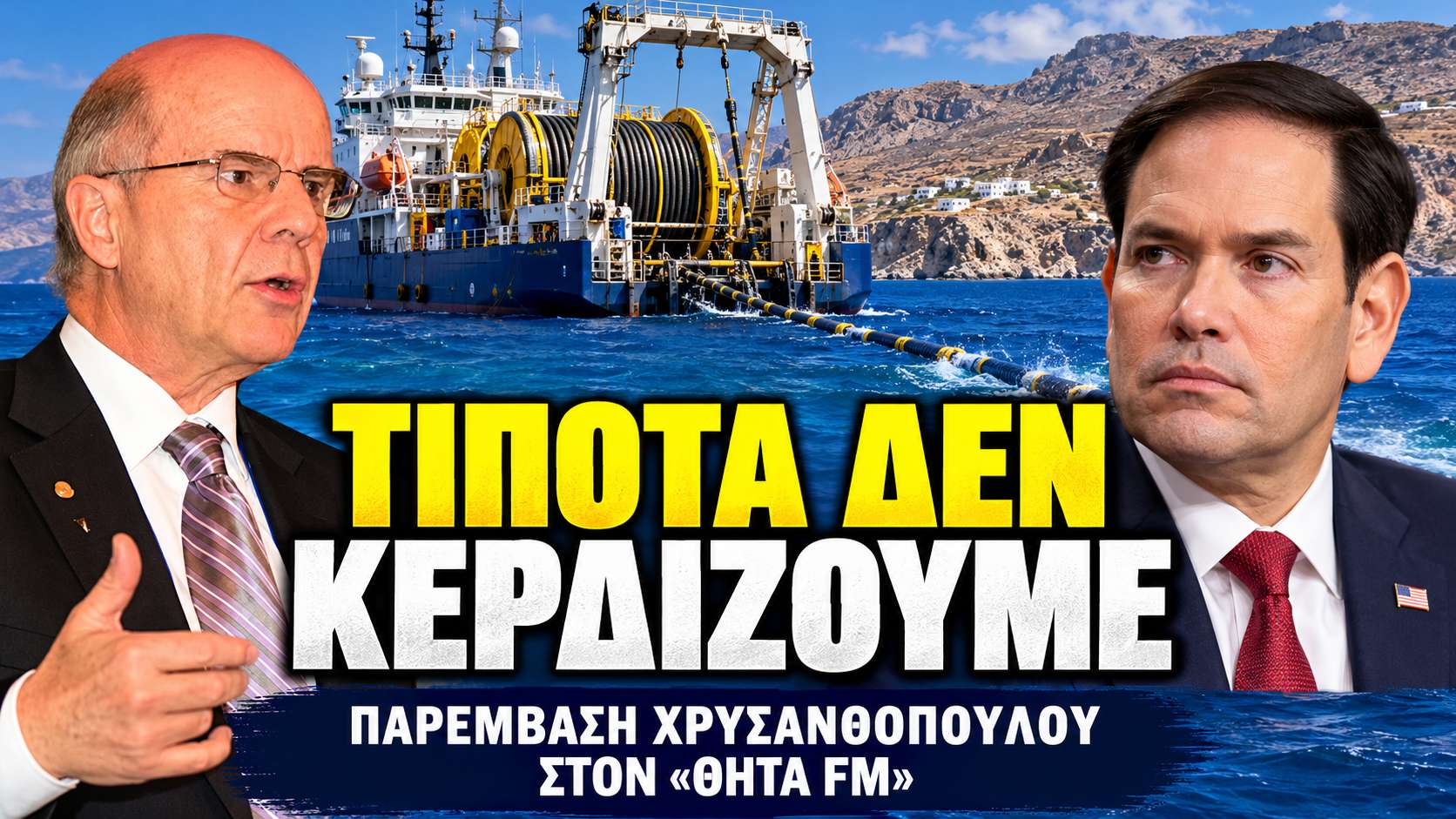
Αιχμηρή κριτική στη στάση του Μάρκο Ρούμπιο απέναντι στο ζήτημα της ηλεκτρικής διασύνδεσης Ελλάδας–Κύπρου άσκησε ο πρέσβης ε.τ. Λεωνίδας Χρυσανθόπουλος, μιλώντας στον Θήτα FM και τη Βασιλική Πολίτου. Υποστήριξε ότι η Αθήνα πρέπει να επιμείνει στην υλοποίηση του έργου στη βάση των δικαιωμάτων της, ενώ έθεσε ζητήματα για την υπόθεση Γκίλφοϊλ, την Κύπρο και τις ελληνικές στρατιωτικές αποστολές στο εξωτερικό.
Ο έμπειρος διπλωμάτης αντιμετώπισε με επιφυλακτικότητα την αποτίμηση της επίσκεψης του Αμερικανού υπουργού Εξωτερικών ως ελληνικής διπλωματικής επιτυχίας. Παρότι χαρακτήρισε θετική κίνηση την επίσκεψη στην Ελλάδα χωρίς αντίστοιχη μετάβαση στην Τουρκία, εκτίμησε ότι αυτό δεν συνεπάγεται ιδιαίτερη ενόχληση της Άγκυρας, επικαλούμενος τις αμερικανοτουρκικές επαφές στο περιθώριο της Γενικής Συνέλευσης του ΟΗΕ.
Το καλώδιο και η απάντηση «βρείτε τα μεταξύ σας»
Στο επίκεντρο της συζήτησης βρέθηκε η απάντηση Ρούμπιο για την ηλεκτρική διασύνδεση και η αναφορά του σε ευαίσθητα ζητήματα που απαιτούν διπλωματικό χειρισμό. Ο Χρυσανθόπουλος ερμήνευσε τη στάση αυτή ως προτροπή προς τις εμπλεκόμενες πλευρές να τα βρουν μεταξύ τους, χωρίς σαφή αμερικανική στήριξη της ελληνικής θέσης.
«Τίποτα δεν κερδίζουμε. Τίποτα δεν κερδίζουμε από αυτό», είπε χαρακτηριστικά, απαντώντας στο ερώτημα της Βασιλικής Πολίτου για το όφελος που αποκομίζει η Ελλάδα από τη συγκεκριμένη τοποθέτηση.
Κατά τον ίδιο, ο Γιώργος Γεραπετρίτης θα έπρεπε να είχε διατυπώσει καθαρά την πρόθεση της Ελλάδας να προχωρήσει το έργο, επικαλούμενος το διεθνές δίκαιο και τη Σύμβαση του ΟΗΕ για το Δίκαιο της Θάλασσας. Η θέση του ήταν ότι η ελληνική πλευρά οφείλει να υπερασπιστεί έμπρακτα τα δικαιώματα που επικαλείται.
«Η δουλειά είναι του ελληνικού κράτους»
Σχολιάζοντας τη συζήτηση γύρω από τη Nexans, ο πρέσβης ε.τ. χαρακτήρισε σωστή την τοποθέτηση της γαλλικής εταιρείας, όπως αυτή παρουσιάστηκε στη συνέντευξη. Έδωσε, ωστόσο, έμφαση στην ευθύνη των κυβερνήσεων Ελλάδας και Κυπριακής Δημοκρατίας να επιμείνουν στην υλοποίηση της διασύνδεσης.
«Η δουλειά δεν είναι της γαλλικής εταιρείας, είναι του ελληνικού κράτους», υπογράμμισε. Με αυτή τη διατύπωση απάντησε στον προβληματισμό που έθεσε η δημοσιογράφος για το ενδεχόμενο να αναλάβει μια ιδιωτική εταιρεία χειρισμούς με πολιτικές συνέπειες για τα ελληνικά κυριαρχικά δικαιώματα.
Να ζητηθούν εξηγήσεις για την υπόθεση Γκίλφοϊλ
Ο Χρυσανθόπουλος στάθηκε ιδιαίτερα και στο δημοσίευμα της Wall Street Journal για δηλώσεις που αποδόθηκαν στην Αμερικανίδα πρέσβη Κίμπερλι Γκίλφοϊλ. Υποστήριξε ότι η ελληνική κυβέρνηση θα έπρεπε εξαρχής να την είχε καλέσει για εξηγήσεις και να είχε ζητήσει προσωπική, δημόσια διάψευση.
Κατά την άποψή του, μια διάψευση μέσω δικηγόρου δεν επαρκεί για να κλείσει πολιτικά το ζήτημα. Χαρακτήρισε προσβολή για την Ελλάδα την εκκρεμότητα που, όπως εκτίμησε, εξακολουθεί να υπάρχει και επέκρινε την αντίδραση Ρούμπιο στη σχετική ερώτηση.
Κύπρος: Προτεραιότητα η αποχώρηση των κατοχικών στρατευμάτων
Ο πρέσβης ε.τ. δήλωσε ότι δεν τον καλύπτει μια γενική αναφορά στην επανένωση της Κύπρου. Όπως τόνισε, πρέπει να αναδεικνύονται η κατοχή, η αποχώρηση των τουρκικών στρατευμάτων και ο συνεχιζόμενος εποικισμός.
Για τον Χρυσανθόπουλο, το πρώτο ζητούμενο είναι η απελευθέρωση του νησιού και η απομάκρυνση των κατοχικών δυνάμεων. Γι’ αυτό και αντιμετώπισε τις γενικές διατυπώσεις περί επανένωσης ως ανεπαρκείς, εφόσον δεν συνοδεύονται από αναφορά στον πυρήνα του προβλήματος.
Ορμούζ και Patriot: Κριτήριο οι ελληνικές ανάγκες
Για το ενδεχόμενο αποστολής ελληνικού πολεμικού πλοίου στα Στενά του Ορμούζ, ο Χρυσανθόπουλος δέχθηκε ότι θα μπορούσε να δικαιολογηθεί η παρουσία ενός πλοίου για την προστασία της ελληνικής εμπορικής ναυτιλίας. Έθεσε, όμως, περιορισμένο πλαίσιο στην αποστολή, επισημαίνοντας τις ανάγκες του Πολεμικού Ναυτικού στην Ελλάδα.
Παράλληλα, ζήτησε την επιστροφή των ελληνικών Patriot από τη Σαουδική Αραβία. Υποστήριξε ότι η σαουδαραβική πλευρά δεν έχει εκπληρώσει οικονομικές και συμβατικές υποχρεώσεις που συνδέονται με την αποστολή, περιλαμβανομένων εξόδων του προσωπικού. Στη βάση αυτής της καταγγελίας, επέκρινε την παράταση της παραμονής τους και υποστήριξε ότι το ΚΥΣΕΑ θα έπρεπε να είχε αποφασίσει την απόσυρσή τους.
Πρόταση για επαναπροσέγγιση με τη Μόσχα
Ο πρώην πρέσβης εισηγήθηκε ακόμη την αποκατάσταση των σχέσεων με τη Ρωσία, θεωρώντας ότι η επίσκεψη Ρούμπιο προσέφερε ευκαιρία να γνωστοποιηθεί μια τέτοια ελληνική πρόθεση. «Θα το ανακοινώσει, όχι να πάρει άδεια», είπε, περιγράφοντας τον τρόπο με τον οποίο, κατά την άποψή του, θα έπρεπε να κινηθεί η Αθήνα.
Σχολίασε επίσης επικριτικά τις αναφορές του Αμερικανού υπουργού στο Ιράν κατά την ομιλία στην Πνύκα, τονίζοντας την ιστορική και πολιτισμική διαδρομή της αρχαίας Περσίας. Τέλος, εξέφρασε επιφυλάξεις για τη συμφωνία συνεργασίας με την Εθνοφρουρά της Φλόριντα, δηλώνοντας ότι θα προτιμούσε συνεργασία με τις Ένοπλες Δυνάμεις των ΗΠΑ.

Mεγάλο τεστ το καλώδιο! Η στήριξη Ρούμπιο πρέπει να φανεί στην πράξη
Το καλώδιο Ελλάδας–Κύπρου εξελίσσεται σε μεγάλη δοκιμασία αποφασιστικότητας. Πώς ερμηνεύει ο Ανδρέας Μουντζουρούλιας τις δηλώσεις Ρούμπιο για τα ενεργειακά έργα...

Συναγερμός στην Άγκυρα για Ελλάδα, Κύπρο και Ισραήλ! Η SETA μιλά για στρατιωτική περικύκλωση της Τουρκίας και πόλεμο σε τέσσερα μέτωπα
Αποκαλυπτική για τον τρόπο με τον οποίο η τουρκική πλευρά αντιλαμβάνεται τη στρατηγική συνεργασία Ελλάδας, Κυπριακής Δημοκρατίας και Ισραήλ είναι...

Η Ελλάδα να προχωρήσει το καλώδιο – Αιχμηρή κριτική στον Ρούμπιο
Αιχμηρή κριτική στη στάση του Μάρκο Ρούμπιο απέναντι στο ζήτημα της ηλεκτρικής διασύνδεσης Ελλάδας–Κύπρου άσκησε ο πρέσβης ε.τ. Λεωνίδας Χρυσανθόπουλος,...

Φόβος για κρίση Ελλάδας-Τουρκίας ώστε να μείνει ο Ερντογάν
Αιχμές για τους ελληνικούς χειρισμούς απέναντι στη Γαλλία, προειδοποίηση για τους Meteor στην Τουρκία και εκτίμηση ότι το τουρκολιβυκό μνημόνιο...


Προειδοποίηση Παυλόπουλου για τους δημοκρατικούς θεσμούς: Όταν ο Κανόνας Δικαίου χάνει την ισχύ του
Την επικίνδυνη παρακμή της Αντιπροσωπευτικής Δημοκρατίας και την αποδυνάμωση των θεσμών της εξετάζει ο πρώην Πρόεδρος της Δημοκρατίας, Προκόπης Παυλόπουλος,...
-
 Αναλύσεις3 εβδομάδες πριν
Το τελεσίγραφο Καλίν την ώρα που η Τουρκία προετοιμάζεται για πόλεμο!
-
 Άμυνα3 μήνες πριν
Ρωσσικό ΜΜΕ: Ελληνικό «μπλόκο» στην απαίτηση για Patriot – Πώς γνωρίζει το Κίεβο απόρρητα στοιχεία για τους πυραύλους μας;
-

 ΑΝΑΡΤΗΣΕΙΣ ΜΕ ΣΗΜΑΣΙΑ2 μήνες πριν
Πακιστανός με καναδική υπηκοότητα ο υπαίτιος της πυρκαγιάς στον Έβρο! Πιθανόν να μετέφερε μετανάστες
-

 GEOPOLITICO1 μήνα πριν
Το διέρρευσε ο Παπαχελάς! Έφεραν τον Καλίν στο Μαξίμου – Τί συζήτησε με τον Μητσοτάκη;
-
 Αναλύσεις1 μήνα πριν
Καραγκιούλ: «Αν Ελλάδα, Κύπρος και Ισραήλ επιτεθούν στην Τουρκία, ο χάρτης του Αιγαίου θα αλλάξει»
-

 ΑΝΑΡΤΗΣΕΙΣ ΜΕ ΣΗΜΑΣΙΑ2 μήνες πριν
Ξέσπασμα της μητέρας της Μυρτούς για την υπόθεση Τζαβέντ Ασλάμ: «Δεν ξεχνώ ποτέ» – «Δήμαρχος των Πακιστανών ο Δούκας»
-

 GEOPOLITICO3 εβδομάδες πριν
Τί λέει Τούρκος δημοσιογράφος για Σάββα Καλεντερίδη; «Έκανε πολύ καλά τη δουλειά του για τη χώρα του – Δεν μπορούσε να τον στριμώξει η ΜİΤ»
-

 Αναλύσεις3 μήνες πριν
Εάν η Τουρκία απορρίψει τη συμφωνία αποχώρησης από την Κύπρο θα απομακρυνθεί δια της βίας