By Michel Chossudovsky Global Research, August 9, 2011
“As I went back through the Pentagon in November 2001, one of the senior military staff officers had time for a chat. Yes, we were still on track for going against Iraq, he said. But there was more. This was being discussed as part of a five-year campaign plan, he said, and there were a total of seven countries, beginning with Iraq, then Syria, Lebanon, Libya, Iran, Somalia, and Sudan.” General Wesley Clark
An extended Middle East Central Asian war has been on the Pentagon’s drawing board since the mid-1990s.
As part of this extended war scenario, the US-NATO alliance plans to wage a military campaign against Syria under a UN sponsored “humanitarian mandate”.
Escalation is an integral part of the military agenda. Destabilization of sovereign states through “regime change” is closely coordinated with military planning.
There is a military roadmap characterised by a sequence of US-NATO war theaters.
This broader military agenda is intimately related to strategic oil reserves and pipeline routes. It is supported by the Anglo-American oil giants.
The July 2006 bombing of Lebanon was part of a carefully planned “military road map”. The extension of “The July War” on Lebanon into Syria had been contemplated by US and Israeli military planners. It was abandoned upon the defeat of Israeli ground forces by Hizbollah.
Israel’s July 2006 war on Lebanon also sought to establish Israeli control over the North Eastern Mediterranean coastline including offshore oil and gas reserves in Lebanese and Palestinian territorial waters.
The plans to invade both Lebanon and Syria have remained on the Pentagon’s drawing board despite Israel’s setback in the 2006 July War: “In November 2008, barely a month before Tel Aviv started its massacre in the Gaza Strip, the Israeli military held drills for a two-front war against Lebanon and Syria called Shiluv Zro’ot III (Crossing Arms III). The military exercise included a massive simulated invasion of both Syria and Lebanon” (See Mahdi Darius Nazemoraya, Israel’s Next War: Today the Gaza Strip, Tomorrow Lebanon?, Global Research, January 17, 2009)
The road to Tehran goes through Damascus. A US-NATO sponsored war on Iran would involve, as a first step, a destabilization campaign (“regime change”) including covert intelligence operations in support of rebel forces directed against the Syrian government.
A “humanitarian war” under the logo of “Responsibility to Protect” (R2P) directed against Syria would also contribute to the ongoing destabilization of Lebanon.
Were a military campaign to be waged against Syria, Israel would be directly or indirectly involved in military and intelligence operations.
A war on Syria would lead to military escalation.
There are at present four distinct war theaters: Afghanistan-Pakistan, Iraq, Palestine and Libya.
An attack on Syria would lead to the integration of these separate war theaters, eventually leading towards a broader Middle East-Central Asian war, engulfing an entire region from North Africa and the Mediterranean to Afghanistan and Pakistan.
The ongoing protest movement is intended to serve as a pretext and a justification to intervene militarily against Syria. The existence of an armed insurrection is denied. The Western media in chorus have described recent events in Syria as a “peaceful protest movement” directed against the government of Bashar Al Assad, when the evidence confirms the existence of an armed insurgency integrated by Islamic paramilitary groups.
From the outset of the protest movement in Daraa in mid-March, there has been an exchange of fire between the police and armed forces on the one hand and armed gunmen on the other. Acts of arson directed against government buildings have also been committed. In late July in Hama, public buildings including the Court House and the Agricultural Bank were set on fire. Israeli news sources, while dismissing the existence of an armed conflict, nonetheless, acknowledge that “protesters [were]
armed with heavy machine guns.” (
DEBKAfile August 1, 2001. Report on Hama, emphasis added)
“All Options on the Table”
In June, US Senator Lindsey Graham (who serves on the Senate Armed Services Committee) hinted to the possibility of a “humanitarian” military intervention directed against Syria with a view to “saving the lives of civilians”. Graham suggested that the “option” applied to Libya under UN Secuirty Council resolution 1973 should be envisaged in the case of Syria:
“If it made sense to protect the Libyan people against Gadhafi, and it did because they were going to get slaughtered if we hadn’t sent NATO in when he was on the outskirts of Benghazi, the question for the world [is], have we gotten to that point in Syria, …
We may not be there yet, but we are getting very close, so if you really care about protecting the Syrian people from slaughter, now is the time to let Assad know that all options are on the table,” (CBS “Face The Nation”, June 12, 2011)
Following the adoption of the UN Security Council Statement pertaining to Syria (August 3, 2011), the White House called, in no uncertain terms, for “regime change” in Syria and the ouster of President Bashar Al Assad:
“We do not want to see him remain in Syria for stability’s sake, and rather, we view him as the cause of instability in Syria,” White House spokesman Jay Carney told reporters Wednesday.
“And we think, frankly, that it’s safe to say that Syria would be a better place without President Assad,” (quoted in Syria: US Call Closer to Calling for Regime Change, IPS, August 4, 2011)
Extended economic sanctions often constitute a leadup towards outright military intervention. A bill sponsored by Senator Lieberman was introduced in the US Senate with a view to authorizing sweeping economic sanctions against Syria. Moreover, in a letter to President Obama in early August, a group of more than sixty U.S. senators called for “implementing additional sanctions… while also making it clear to the Syrian regime that it will pay an increasing cost for its outrageous repression.”
These sanctions would require blocking bank and financial transactions as well as “ending purchases of Syrian oil, and cutting off investments in Syria’s oil and gas sectors.” (See
Pressure on Obama to get tougher on Syria coming from all sides – Foreign Policy, August 3, 2011).
Meanwhile, the US State Department has also met with members of the Syrian opposition in exile. Covert support has also been channelled to the armed rebel groups.
Dangerous Crossroads: War on Syria. Beachhead for an Attack on Iran
Following the August 3 Statement by the Chairman of the UN Security Council directed against Syria, Moscow’s envoy to NATO Dmitry Rogozin warned of the dangers of military escalation:
“NATO is planning a military campaign against Syria to help overthrow the regime of President Bashar al-Assad with a long-reaching goal of preparing a beachhead for an attack on Iran,…
“[This statement] means that the planning [of the military campaign] is well underway. It could be a logical conclusion of those military and propaganda operations, which have been carried out by certain Western countries against North Africa,” Rogozin said in an interview with the Izvestia newspaper… The Russian diplomat pointed out at the fact that the alliance is aiming to interfere only with the regimes “whose views do not coincide with those of the West.”
Rogozin agreed with the opinion expressed by some experts that Syria and later Yemen could be NATO’s last steps on the way to launch an attack on Iran.
“The noose around Iran is tightening. Military planning against Iran is underway. And we are certainly concerned about an escalation of a large-scale war in this huge region,” Rogozin said.

Dmitry Rogozin, August 2011
While Libya, Syria and Iran are part of the military roadmap, this strategic deployment if it were to carried out would also threaten China and Russia. Both countries have investment, trade as well as military cooperation agreements with Syria and Iran. Iran has observer status in the Shanghai Cooperation Organization (SCO).
Escalation is part of the military agenda. Since 2005, the US and its allies, including America’s NATO partners and Israel, have been involved in the extensive deployment and stockpiling of advanced weapons systems. The air defense systems of the US, NATO member countries and Israel are fully integrated.
The Role of Israel and Turkey
Both Ankara and Tel Aviv are involved in supporting an armed insurgency. These endeavors are coordinated between the two governments and their intelligence agencies.
Israel’s Mossad, according to reports, has provided covert support to radical Salafi terrorist groups, which became active in Southern Syria at the outset of protest movement in Daraa in mid-March. Reports suggest that financing for the Salafi insurgency is coming from Saudi Arabia. (See
Syrian army closes in on Damascus suburbs, The Irish Times, May 10, 2011)
The Turkish government of Prime Minister Recep Tayyib Erdogan is supporting Syrian opposition groups in exile while also backing the armed rebels of the Muslim Brotherhood in Northern Syria.Both the Syrian Muslim Brotherhood (MB) (whose leadership is in exile in the UK) and the banned Hizb ut-Tahrir (the Party of Liberation) are behind the insurrection. Both organizations are supported by Britain’s MI6. The avowed objective of both MB and Hizb-ut Tahir is ultimately to destabilize Syria’s secular State. (See Michel Chossudovsky,
SYRIA: Who is Behind The Protest Movement? Fabricating a Pretext for a US-NATO “Humanitarian Intervention”, Global Research, May 3, 2011).
In June, Turkish troops crossed the border into northern Syria, officially to come to the rescue of Syrian refugees. The government of Bashar Al Assad accused Turkey of directly supporting the incursion of rebel forces into northern Syria:
“A rebel force of up to 500 fighters attacked a Syrian Army position on June 4 in northern Syria. They said the target, a garrison of Military Intelligence, was captured in a 36-hour assault in which 72 soldiers were killed in Jisr Al Shoughour, near the border with Turkey.
“We found that the criminals [rebel fighters] were using weapons from Turkey, and this is very worrisome,” an official said.
This marked the first time that the Assad regime has accused Turkey of helping the revolt. … Officials said the rebels drove the Syrian Army from Jisr Al Shoughour and then took over the town. They said government buildings were looted and torched before another Assad force arrived. …
A Syrian officer who conducted the tour said the rebels in Jisr Al Shoughour consisted of Al Qaida-aligned fighters. He said the rebels employed a range of Turkish weapons and ammunition but did not accuse the Ankara government of supplying the equipment.” (Syria’s Assad accuses Turkey of arming rebels, TR Defence, Jun 25 2011)
The Israel-Turkey Military Cooperation Agreement
Israel and Turkey have a military cooperation agreement which pertains in a very direct way to Syria as well to the strategic Lebanese-Syrian Eastern Mediterranean coastline (including the gas reserves off the coast of Lebanon and pipeline routes).
Already during the Clinton Administration, a triangular military alliance between the US, Israel and Turkey had unfolded. This “triple alliance”, which is dominated by the US Joint Chiefs of Staff, integrates and coordinates military command decisions between the three countries pertaining to the broader Middle East. It is based on the close military ties respectively of Israel and Turkey with the US, coupled with a strong bilateral military relationship between Tel Aviv and Ankara. ….
The triple alliance is also coupled with a 2005 NATO-Israeli military cooperation agreement which includes “many areas of common interest, such as the fight against terrorism and joint military exercises. These military cooperation ties with NATO are viewed by the Israeli military as a means to “enhance Israel’s deterrence capability regarding potential enemies threatening it, mainly Iran and Syria.” (See Michel Chossudovsky,”Triple Alliance”: The US, Turkey, Israel and the War on Lebanon, August 6, 2006)
Meanwhile, the recent reshuffle within Turkey’s top brass has reinforced the pro-Islamist faction within the armed forces. In late July, The Commander in Chief of the Army and head of Turkey’s Joint Chiefs of Staff, General Isik Kosaner, resigned together with the commanders of the Navy and Air Force.
General Kosaner represented a broadly secular stance within the Armed Forces. General Necdet Ozel has been appointed as his replacement as commander of the Army the new army chief.
These developments are of crucial importance. They tend to support US interests. They also point to a potential shift within the military in favor of the Muslim Brotherhood including the armed insurrection in Northern Syria.
Muslim Brotherhood Rebels at Jisr al Shughour Photos AFP June 16, 2011
[Note: this photo is in many regards misleading. Most of the rebel gunmen are highly trained with modern weapons.]
The Extended NATO Military Alliance
Egypt, the Gulf states and Saudi Arabia (within the extended military alliance) are partners of NATO, whose forces could be deployed in a campaign directed against Syria.
Israel is a de facto member of NATO following an agreement signed in 2005.
The process of military planning within NATO’s extended alliance involves coordination between the Pentagon, NATO, Israel’s Defense Force (IDF), as well as the active military involvement of the frontline Arab states, including Saudi Arabia, the Gulf States, Egypt: all in all ten Arab countries plus Israel are members of The Mediterranean Dialogue and the Istanbul Cooperation Initiative.
We are at a dangerous crossroads. The geopolitical implications are far-reaching.
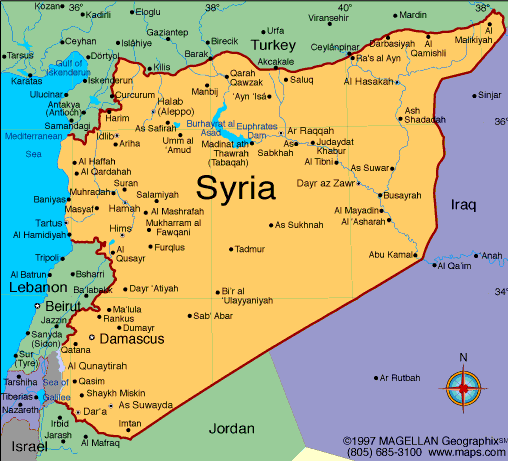
Syria has borders with Jordan, Israel, Lebanon, Turkey and Iraq. It spreads across the valley of the Euphrates, it is at the crossroads of major waterways and pipeline routes.
Syria is an ally of Iran. Russia has a naval base in North Western Syria (see map).
Establishment of a base in Tartus and rapid advancement of military technology cooperation with Damascus makes Syria Russia’s instrumental bridgehead and bulwark in the Middle East.
Damascus is an important ally of Iran and irreconcilable enemy of Israel. It goes without saying that appearance of the Russian military base in the region will certainly introduce corrections into the existing correlation of forces.
World War III Scenario
For the last five years, the Middle East-Central Asian region has been on an active war footing.
Syria has significant air defense capabilities as well as ground forces.
Syria has been building up its air defense system with the delivery of Russian Pantsir S1 air-defense missiles. In 2010, Russia delivered a Yakhont missile system to Syria. The Yakhont operating out of Russia’s Tartus naval base “are designed for engagement of enemy’s ships at the range up to 300 km”. (
Bastion missile systems to protect Russian naval base in Syria, Ria Novosti, September 21, 2010).
The structure of military alliances respectively on the US-NATO and Syria-Iran-SCO sides, not to mention the military involvement of Israel, the complex relationship between Syria and Lebanon, the pressures exerted by Turkey on Syria’s northern border, point indelibly to a dangerous process of escalation.
Any form of US-NATO sponsored military intervention directed against Syria would destabilize the entire region, potentially leading to escalation over a vast geographical area, extending from the Eastern Mediterranean to the Afghanistan-Pakistan border with Tajikistan and China.
In the short run, with the war in Libya, the US-NATO military alliance is overextended in terms of its capabilities. Whiel we do not forsee the implementation of a US-NATO military operation in the short-term, the process of political destabilization through the covert support of a rebel insurgency will in all likelihood continue.
Πηγή: Global Research
var _wau = _wau || []; _wau.push([“small”, “wvg1ie6mi5ta”, “m3y”]);
(function() {var s=document.createElement(“script”); s.async=true;
s.src=”http://widgets.amung.us/small.js”;
document.getElementsByTagName(“head”)[0].appendChild(s);
})();